Wednesday, March 11, 2009

Bloody Reunion

If you know me, you know I have a weakness for violent Korean films, even when they're not very well executed. Bloody Reunion is a fairly decent shocker, but it suffers from an attempt at a twist ending that is more a WTF? ending that makes absolutely no sense. So instead of letting that ruin the fun, I'll just pretend the movie ends a bit before the lame mind-fuckery bit and discuss the rest of it.

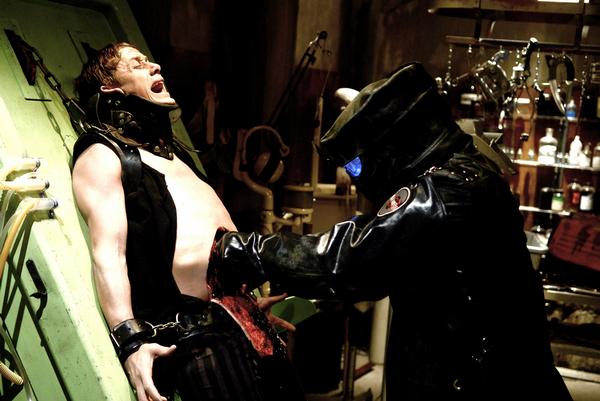
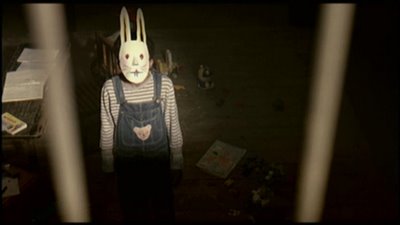
Seems a rural teacher running a one-room school out of her seaside home gave birth to a boy with facial deformities so hideous her husband hanged himself. She raised the little tyke in the basement (that's him above in the bunny mask), her students taking time out periodically to taunt him. It's twenty years later and a bunch of the now-all-grown-up students decide to visit their old teacher. See where this is going? That's right, you got it: Homicidal maniac in a bunny mask picking off the guests one by one. But is it the son, or another member of the group?

What makes this otherwise routine exercise more interesting is the gradual reveal that ol' Mrs. Park wasn't the caring, loving teacher her former students have come to celebrate (with liberal amounts of soju, beer and raspberry home brew). No, she was actually a nasty piece of work, humiliating, crippling, even molesting her little charges all those years ago. The tension of these revelations intermingles with the slasher plot to create an interesting new hybrid of suspense.

But remember: You gotta really be into dark Korean cinema to enjoy this one. Don't say I didn't warn you.

Tuesday, March 10, 2009

Pitfall

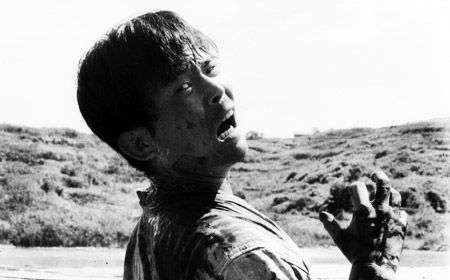
Hiroshi Teshigahara's feature film debut, Pitfall (Otoshiana, 1962) features ghosts, but it's not a ghost story. There's a murderer running around and the cops are investigating, but it's not a police procedural. And while the plot of the film concerns coal miners and factional infighting among union leaders, the film is certainly no didactic, left-wing screed. No, Teshigahara was first and foremost an aesthete, and this film, like his Woman of the Dunes (1964), The Face of Another (starring Tatsuya Nakadai, 1966), The Ruined Map (starring Shintaro Katsu, 1968), Rikyu (starring Rentaro Mikuni, 1989) and others, should be approached as an exercise in pure cinematic art. Sound and texture are the fundamental considerations here. Working with his longtime musical colaborator, sonic abstract expressionist Toru Takemitsu, Teshigahara brings us slowly and steadily into a stark, disorienting mirror world of our own full of uncertainty and existential dread.

After a destitute miner is stabbed to death for no apparent reason by a scooter-driving man in white (Kunie Tanaka), the dead man's ghost proceeds to wander around in a state of aggrieved perturbation, trying to figure out what the hell just happened. He is ignored by the cops as they examine his bloody corpse in a moment of ultimate beuraucratic disregard. Turns out he's the spitting image of a local union official. Was the murder a mistake ... or a warning? A woman who witnessed the murder is paid off by the murderer to give false evidence, only to be murdered herself by the same guy later on. When the two ghosts finally meet to discuss their mutual situations (ghosts can see each other but are invisible to the living), we get the kind of exchange I'd like to see a whole lot more of in contemporary film.

Luckily for you in the US, Criterion Collection released Pitfall in a box along with Woman of the Dunes and The Face of Another a couple of years ago, so you can get that and spend a profound weekend in the art house ethos of one of Japan's finest creative minds. (My copy of Pitfall is from the UK label Eureka, part of their Masters of Cinema series, England's answer to Criterion with a lot of titles you won't find on this side of the pond.)

Monday, March 9, 2009

Japanese Gore Roundup

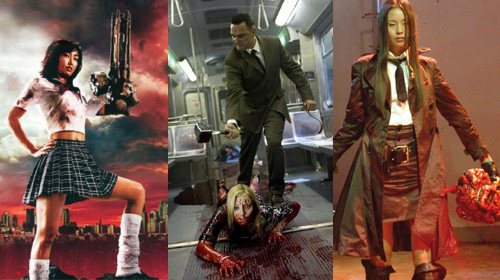
While I admit I was curious at the prospect of Midnight Meat Train, I couldn't deny a premonition deep in my soul that it would be crap. Sadly, I was right. Penned by Clive Barker and directed by high-octane Japanese filmmaker Ryuhei Kitamura (who gave us Versus and Azumi), the film is defeated by what appears to be a demand by the producers never to step beyond the most basic expectations created by the phrase "midnight meat train." In other words, the story is thin on the ground, getting even thinner once we delve underground and hop aboard the titular light rail vehicle. For all it's splatitude (a favorite recurring image is that of an individual slipping on, falling into, and rising covered in thick, glistening gore), the only truly scary thing in the picture is Vinnie Jones (but he's just scary period, so no kudos there). Only at the tag end of the film do we get any sort of backstory, concerning a hungry population of demonic, C.H.U.D.-like things, but by then it's too late and the credits follow hard upon.

Then there's Tokyo Gore Police and The Machine Girl, which make Midnight Meat Train look like Citizen Kane. TGP has the better budget of the two and features Eihi Shiina (whom most of us fell hard for in Audition, despite her proclivities toward torture and amputation in that flick). Both films try their best to shock, with techno-body horror, fire hydrant-worthy blood showers and every manner of mutilation imaginable. However, the efforts of the filmmakers go right past shocking into patently ridiculous, causing even a stalwart such as me to wonder whether he's wasting his time. I kept imagining a 12-year-old boy sitting watching these films, loving every gooey, outrageous minute; that's clearly the target audience here. It reminded me of the first time I saw a Rambo picture, that chilling feeling that this film was made for someone very different from me, and that I was never going to get into it like that other individual.

While The Machine Girl revolves around a school girl getting revenge on the bullies who killed her brother (and some of their brutal yakuza relatives), Tokyo Gore Police offers a more interesting back story (although this too boils down to revenge). In the end, though, I can't in good conscience recommend either unless you, like I, have a professional interest in keeping abreast of such things. And even then, it will feel more like work than pleasure.

Tuesday, February 24, 2009

Repo! The Genetic Opera

OK, so it ain't Asian, but it's plenty shocking. I was attracted to the central conceit, that of a repo man who runs around unceremoniously ripping transplanted organs out of people who miss their payments (a trend we should be seeing any day now ...). I wasn't so sure about the rock opera dimension, and I really had my doubts about the presence of a certain Hotel heiress named after a big city in France. Yet somehow it all works. Sure some of the sappy scenes go on a bit too long, but hey, this is opera! It's all singing, all the time in this film, which actually works better for me than the standard musical format where people are talking one minute and singing the next. And what they're singing about is so dark and demented, it makes for ghastly fun. Who knew Paul Sorvino had such a great set of pipes! Bill Moseley has a small role as a psycho (of course), but the real star of the piece is Terrance Zdunich, one of the two creators of the original theatrical piece from which the film is adapted. He plays a gothy graverobber and has the best scenes in the picture (apart from the numerous repossessions).

So take a chance on this one. Quite original and a bloody feast for the eyes and ears.

Saturday, January 31, 2009

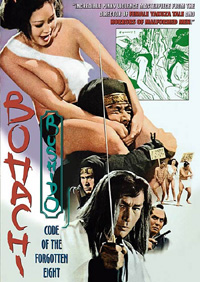
Bohachi Bushido: Code of the Forgotten Eight

The Japanese title of this film is Porno jidaigeki: Bohachi bushido. Jidaigeki means "period drama," bushido is the Way of the Warrior, the bohachi were sex slavers who had renounced the eight principles of Confucian ethics (sometimes called bohachimono, as in Lone Wolf & Cub: Baby Cart to Hades), and we all know what porno is (although in this case it's decidedly softcore).

My friend Lonny was raving about this film the other day. I told him I didn't think that highly of it (I had a bootleg long before the recent release from Discotek). He urged me to take another look, and, indeed, it played better this time (although I think I'd prefer to read the original manga by Kazuo Koike upon which it's based).

The best thing about the movie, in my opinion, is the sword action. Tetsuro Tamba knew how to use a sword, and his stoic, world-weary ronin has a certain vintage Clint Eastwood vibe as he rips and dismembers scores of attackers, later uttering his catchy catch-phrase, "To die is hell, but to live is also hell."

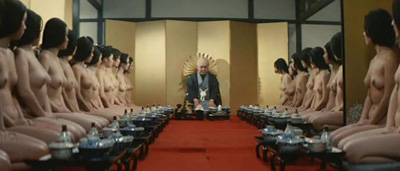
Of course what most guys like about the film is the wall-to-wall naked female flesh, a dimension to which I'm certainly not opposed, but feel could have been handled better. Director Teruo Ishii phoned it in on this one I think, throwing tits 'n ass around haphazardly with little effort at eroticism. Now maybe I'm just see-through faded, super-jaded and out of my mind, but for me Tamba's protracted opium and sex orgy scene was downright soporific, and that ain't right! A scene like that should have me at full attention so to speak, and I blame Ishii for not making that happen. (Check out Norifumi Suzuki's Convent of the Sacred Beast for an example of what I consider the right way to do lubricious love.)

So I put it to you, dear reader: If you've seen this film, leave a comment (you have to have a blogger account, unfortunately). Let me know if you feel Bohachi Bushido is hotter than hot or merely luke warm.

Tuesday, January 13, 2009

Karaoke Terror

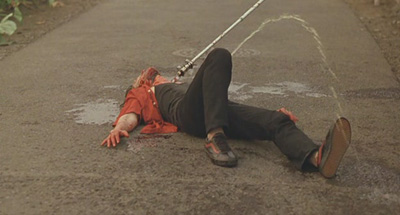
What is wrong with this picture? Well for one thing, the guy's got a makeshift spear sticking out of his neck and, in addition, appears to be having a hell of a piss as he expires from his wound (seems he was doing his business up against a fence when a woman on a scooter came by and harpooned him). This is one of several violent set pieces that serve more as MacGuffins than truly defining moments in what is essentially an offbeat indie film, rather than anything deeply dark or transgressive.

I'll admit I was a bit disappointed by Karaoke Terror (2003), a film that seems to want to stand alongside cinematic works like Dead or Alive and Battle Royale, but in the end just doesn't have the goods. Don't get me wrong, it has its own special charm, but charm isn't what I was looking for in a tale of two groups of karaoke pals (young guys in one, middle-aged women in the other) who wage an ever-escalating war against one another after one of the guys casually slashes one of the women to death in a rainy garden. It's based on the novel Popular Hits of the Showa Era by Ryu Murakami (who also gave us Audition), and I wonder if the source material wasn't a bit more intense than this playful rendering.

Great cast, though. There's Masanobu Asano, memorable for his red-headed psycho in Battle Royale and plucky boxer in Kid's Return; Ryuhei Matsuda, the androgynous Shinsengumi member in Taboo and the boa constrictor-wearing God/Satan character in Izo; Kayoko Kishimoto, Beat Takeshi's dying wife in Fireworks; Yoshio Harada, who's been in more great films than I could begin to list here (try Hunter in the Dark and Roningai for starters); and the manga-cute Miwako Ichikawa, who co-starred with Harada in Another Heaven.

Karaoke Terror isn't a bad movie, just a little too precious for this dark cinema aficionado.

Monday, January 12, 2009

Seeding of a Ghost

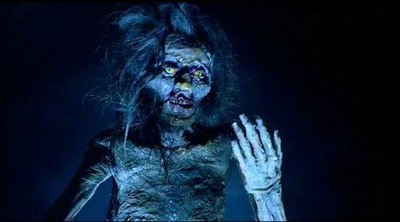
Is it really necrophilia if both sex partners are dead? What if the woman's corpse gets it on with the disembodied spirit of a man who'd previously raped her? And if, afterwards, the corpse's belly, fed with the blood of her grieving widower, distends into a glowing, pregnant orb and somehow discharges a monstrous hell spawn from the womb of the wife of the man who'd been the corpse woman's lover that in turn mutilates and dismembers the guests at a mah jong get-together, that's a good thing, right? It's questions like these that you'll have to face while looking on in horror at the Category III movie madness that is Seeding of a Ghost (1983), one of the most shockingly grotesque films ever to emerge from Hong Kong's own Shaw Brothers Studios. Most folks think of kung fu fighting when they hear the Shaw Brothers' name, but the studio cranked out a fair amount of jaw-dropping horror as well, as here in this film I only wish I'd covered in Asia Shock. I should mention that along the way we get scenes of people vomiting worms; a witchdoctor casting evil spells, his facial features growing more disfigured with every hex; a guy eating brains out of a coconut, washing it down with blood; a lot of nudity; some kung fu action; oh and that demonic thing, all fangs and tentacles, with a retractable human head to boot. Sure it gets a bit cheesy at times, like when an enterprising doctor jams a barbell into the jaws of the beast to comedic effect, but overall this is one outrageous splatterfest you won't want to miss.