Wednesday, August 26, 2009

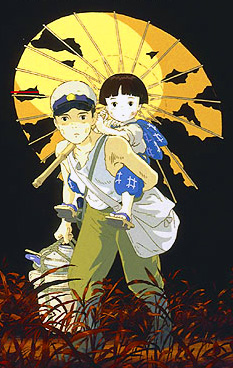
Grave of the Fireflies

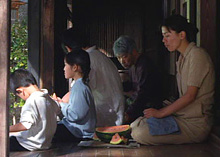
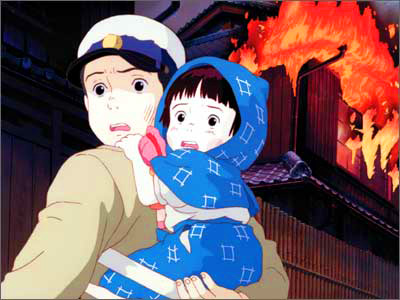
When we think of war, we tend to think first of the violence, death and atrocities, the soldiers, bombs, planes, tanks, guns, the whole grand theater of destruction that is war on the large scale. But what of the survivors? Their tears? Their grief? The untold agonies they must endure? Imagine the unbearable anguish of having to look on, helpless, as your dearest loved one slowly dies before your eyes, and there's no one there to help. If you find all of this depressing, then I'd advise against viewing Grave of the Fireflies (1988).

It's hard to know who the target audience is for this feature-lengh anime tale of a brother and sister trying to survive in WWII-torn Japan. Too heavy for kids, too dismal and heartbreaking for anyone else, it's a wonder anyone would want to watch it at all. And yet it's a film that should be seen, if for no other reason than to remind us all just what the human cost of war really amounts to.

Grave of the Fireflies is fairly apolitical (the filmmakers scrupulously avoid any form of didactic statement, focusing solely on the protagonists' efforts to survive) and thus serves as a universal tale -- these could be any two kids in any war-ravaged land. Maybe modern kids should watch this film, regardless of the trauma it might inflict; by simply presenting a narrative that no doubt actually occurred a thousand times over, the ultimate tragedy of war comes across more clearly than in any war film (or anti-war film) I've ever seen. My advice: Keep a box of kleenex handy.

Monday, August 24, 2009

Big Man Japan

Last year I had a chance to see Big Man Japan at the San Francisco International Film Festival. However, I had a scheduling conflict: I was in Tokyo on the day of the showing (scouting images for Warring Clans, Flashing Blades). I was somewhat bummed, as this was the one film among that year's SFIFF offerings I most wanted to see. Now, having seen it, I realize I needn't have bothered.

The simple fact of the matter is that Big Man Japan, for all its low-key, indie quirkiness, simply doesn't work. Chief among its problems is precisely its low-key, indie quirkiness. This is ostensibly a film about kaiju, giant monsters. Mere mention of the genre immediately engenders images and expectations ranging from the kinetic to the phrenetic -- certainly not the pathetic. Big Man Japan, while well made and lovingly executed, is nevertheless so downbeat and deadpan as to sap any and all energy from a story about a sixth-generation super hero who, with the help of massive jolts of electricity, grows to gigantic proportions to fight an array of bizarre, enormous creatures who routinely plague the more built-up parts of Tokyo. There's a monster that uproots tall buildings with its big, rubber-band arms; a fella with a big ol' eyeball on a stalk growing out of his crotch; a smelly, squid-like thing whose chief talent appears to be arguing; a humongo-demon-baby; hell, there's even a big Riki Takeuchi head bouncing around on a single, muscular leg. And through it all we have Hitoshi Matsumoto, our writer/director/star, portraying the Big Man as a likable looser, a slacker who doesn't get it and does a substandard job of giant superhero-ing (he's frequently upstaged by his similarly-enormo grandad).

Matsumoto is clearly taking a cue from Watchmen -- real-life superhero, hated by the public, trying to deal with personal problems and generally having a tough time. It's a shame he opted for a dull, documentary format to explore what could have been a genuinely engaging fantasy adventure film with deconstruction, social commentary and really weird monsters into the bargain.

In four words: Great concept, crap execution.

Monday, August 17, 2009

Warring Clans, Flashing Blades review

Some encouraging words from Matthew Caron over at hip NYC blog Vol. 1 Brooklyn. I was just in Brooklyn last year, visited some friends in Flatbush. Gotta get back over there ...

Anyhow, thanks Matthew!

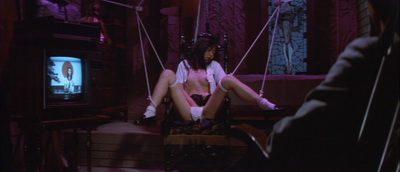
Star of David: Beauty Hunting

OK, so I'm still shockable (see previous post). However when it comes to 70s Japanese exploitation cinema, it would appear that I've become almost completely jaded. Take, for example, Star of David: Beauty Hunting (aka Star of David: Hunting for Beautiful Girls), a late entry from 1979. Here we have a tale of a handsome young sociopath who idolizes Hitler and indulges in serial rape, torture and murder. Oh you'll get your money's worth with this dark little ditty (adapted from a manga, or more precisely gekiga, by Masaaki Sato). In addition to the standard trifecta already mentioned, there's a fair amount of Japanese rope bondage, a bit of necrophilia, some unique scenes of father-and-son psycho-killing, and lots of humiliation (anyone for forced urination?).

And through it all, I hardly batted an eye. This could be due to a certain slickness of production -- the film was directed by Norifumi Suzuki, my favorite Toei exploitation filmmaker (who, in fact, made this film for Nikkatsu). Suzuki was a consummate pro, and a master of tastefully made tasteless films. He had an arty flair that could make just about any abomination palatable (see his Sex and Fury and Convent of the Sacred Beast for other examples). However, one gets the impression that even Suzuki was growing tired of all the lurid horribleness. At one point, in what seems an effort to take the edge off, he inserts a cameo of Bunta Sugawara and Kinya Aikawa, stars of the uproarious Torakku yaro (Truck Guys) film series (ten of which Suzuki directed in the mid-70s). There they are, cruising down the highway in their colorfully painted dekotora, their dialog significantly raunchified for the purposes of the picture (some nonsense about judging a woman's private parts by the size and shape of her nose).

Star of David: Beauty Hunting is a good flick if you're looking to get your kinky psycho freak on, but beyond that, well, let's just say it's an acquired (tastefully tasteless) taste.

Tuesday, August 4, 2009

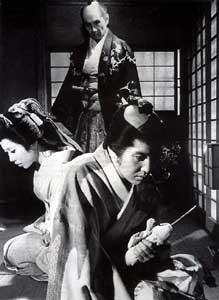
Cruel Tales of Bushido

You know, I've seen a lot of samurai films in my time, so it's not every day that one comes along and blows me away. But that's just what happened yesterday. The film? Cruel Tales of Bushido (1963), directed by Tadashi Imai. Jidai-geki superstar Kinnosuke Nakamura turns in a devastating performance -- or should I say half a dozen or more -- portraying a succession of ancestors stretching from the dawn of the Tokugawa period (early 17th century) right up to the present day (the present being the early 1960s). In each vignette, a male member of the Iikura family is forced to endure some humiliating, if not downright heinous, demand from his feudal lord. Each time he submits, following the strict tenets of bushido, the "code of the warrior." Things ratchet up with each succeeding generation, the cruel treatment becoming mind-bendingly sadistic. Imagine the worst thing you could do to a man -- yep, that happens in this film. And through it all, the Iikura men obediently comply, never standing up, never fighting back. Are they all model samurai or merely pitiable fools?

While director Imai, an outspoken leftist with a flair for didactic, political statement films, pushes the cruelty envelope throughout the film, there's no denying that such abuses were not uncommon. Indeed, Imai asserts that such practices are ongoing, tracing the same abusive lord/vassal relationship to the modern, corporate world. While I wasn't crazy about his Adauchi (Revenge, 1964), I have to say this film is an unqualified masterpiece, a timeless tragedy and a crowning achievement

Cruel Tales of Bushido won the Golden Bear award at the 1963 Berlin Film Festival.

Tuesday, July 28, 2009

Laying low

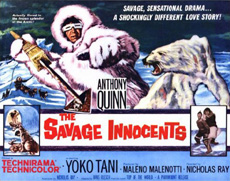
Sorry for the paucity of posts recently. I've been reading a lot and not looking at any particularly shocking films, Asian or otherwise. No, wait, I tell a lie: The Savage Innocents (1960), Nicholas Ray's eskimo saga, has some pretty shocking footage of actual polar bear and walrus hunts. That was hard to watch. (This is also the film that inspired Bob Dylan to write the song Quinn the Eskimo -- for its star, Anthony Quinn -- covered by Manfred Mann in 1968. Seeing the film clears up strange lines like "ain't my cup of meat.")

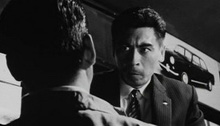
A Taxing Woman (1987), Juzo Itami's follow-up to Tampopo, starring, once again, his wife Nobuko Miyamoto and the great Tsutomu Yamazaki (the cowboy trucker in Tampopo as well as the kidnapper in Kurosawa's High & Low) wasn't what I (or anyone back in 1987) was expecting. While the previous film had been frothy, fanciful and funny, this film, about a gung-ho tax inspector and her unexpectedly complex relationship with a crooked, yakuza-related business man, is a bit long and somewhat downbeat. Fine film, just not as funny as I thought it would be. Incidentally, the real yakuza didn't take kindly to Itami's portrayal of them -- he wound up getting knifed for his efforts. True story.

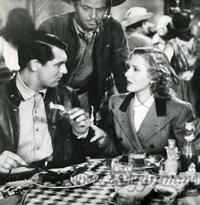
Tiger Shark (1932) and Only Angels Have Wings (1939) are big, manly movies courtesy of legendary Hollywood director Howard Hawks. The former is all about the perils of the commercial fishing trade (lots of sharks!) and stars Edward G. Robinson doing a cheesy Portugese accent and falling in love with with the wrong woman. Body parts get chomped left and right in this flick, as well as a hook in the face and other instances of nautical nastiness. Only Angels Have Wings has Cary Grant as a mail courier based in Brazil (or some Brazil-like country) who, with his rag-tag gang of fliers, risks life and limb to get the mail (or whatever) to remote, mountainous, always-dangerous locations. Jean Arthur is sweet on him, his ex is Rita Hayworth (in an early and rather embarrassing performance) and his men represent a stable of great character actor talent from the period. Also, look for once-huge silent star Richard Barthelmess in a rather unrewarding role as a hated, black sheep pilot.

The Japanese word maborosi translates as phantom, vision, illusion, and also sounds like the English word morose. So with the film Maborosi (1995), we have a subtle, haunting meditation on love, loss, grief and starting over in a small Japanese fishing village. The original title is Maborosi no hikari which means something like "phantom light" -- a reference to a tale told by an old fisherman toward the end of the film. In other words, there ain't no ghosts. An arthouse slow burn, this film gets slower and slower as you go. Only the atmoshpere saves it. See what you think.

Mishima: A Life in Four Chapters (1985) isn't a Japanese film, although it's all in Japanese and stars Japanese actors. It's Paul Schrader's tribute to famed novelist Yukio Mishima (who famously committed seppuku in 1970 following a doomed political misadventure). The film follows Mishima's life while meandering in and out of stagey interpretations of several of his stories, drawing obvious parallels throughout. One reason to see it is the great Ken Ogata in the starring role. Another is Kenji Sawada (Samurai Reincarnation, Hiruko the Goblin, Happiness of the Katakuris) in one of the vignettes. If you would like to see the real Yukio Mishima in a movie, he starred as a feckless yakuza in Yasuzo Masumura's Afraid to Die (1960), did a blink-and-you'll-miss-him bit as a human doll in Kinji Fukasaku's Black Lizard (1968) and had a small role in Hideo Gosha's Tenchu (1969) wherein he ... wait for it ... commits seppuku!

Black Test Car (1962) was recently released on disk by Fantoma. It's an industrial espionage film concerning rival car companies and all the skullduggery their corporate spies get up to (like bribery, blackmail, prostitution, kidnapping, assault, you name it). Directed by one of my favorite Japanese directors, Yasuzo Masumura, this film makes a great double feature with his Giants and Toys (1958), another corporate saga, albeit a much funnier one (though still fairly dark) about the battles between three competing caramel companies.

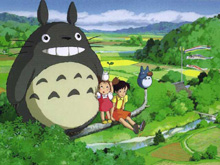
And I have to admit I was completely charmed by My Neighbor Totoro (1988), an anime feature from Hayao Miyazaki. So much so, in fact, that I bought a copy for a neighbor's 2-year-old daughter (who was herself completely entranced). It's hard to describe: The vibe is so sweet and gentle and filled with such a genuine sense of childlike wonder. I was really surprised by the degree to which it moved an old curmudgeon like me. Go figure.

Tuesday, July 14, 2009

Warring Clans, Flashing Blades OUT NOW!!!

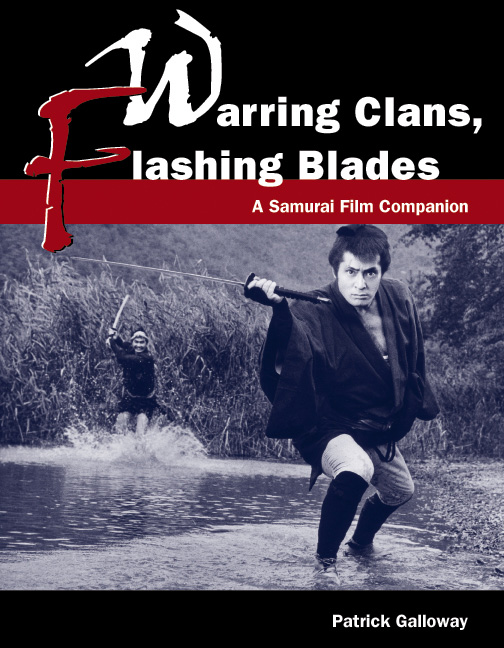
OK, it's official. My new book, Warring Clans, Flashing Blades: A Samurai Film Companion has hit the street. Order it now from Amazon.com or, better yet, demand that your local bookstore carry it. Yeah, that's the ticket -- insist, perhaps with a bit of menace in your voice, that they place a sizable order with Stone Bridge Press for this particular title. Then mention, with a certain sinister silkiness, that said purchase will help them stay in business (if they know what's good for them). A little bit of such friendly persuasion will help me and will go a long way to solidifying your reputation around the neighborhood as a formidable strongman on his way up.

So what are you waiting for? Get out there and, as the Brits say, put some stick about!