Saturday, November 21, 2009

Red Angel

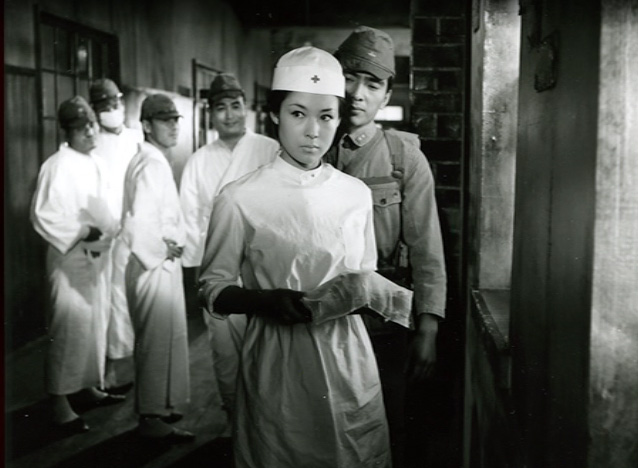
Anyone interested in World War II really owes it to himself to check out some Japanese WWII pictures. It's quite a different perspective from the losing side, and while there were plenty of films made with a hurray-for-us-anyway-we-did-our-best sensibility, the ones I find most compelling are those that strip away the heroics and patriotism and examine the reality of war. Such films include Masaki Kobayashi's The Human Condition trilogy, Kon Ichikawa's Fires on the Plain and The Burmese Harp and Yasuzo Masumura's Red Angel (1966). While less well-known than the others, Red Angel nevertheless stands alongside these classics in terms of its virtuosity and shocking veracity.

The angel of the piece is an army nurse, Sakura Nishi (Ayako Wakao), shipped off to Manchuria to work in field hospitals in 1939. Her first day on the job, she's raped by one of the patients. He turns up later on a table with a hole in his belly and, despite his despicable act, Nurse Nishi takes pity on him, lobbying for extra care even though he's a goner. Yes, she's a sweetheart, a loving, giving woman whose compassion for the men she encounters extends above an beyond the call of duty. I don't want to give too much away, but suffice to say you will never forget this movie or the character of Sakura Nishi.
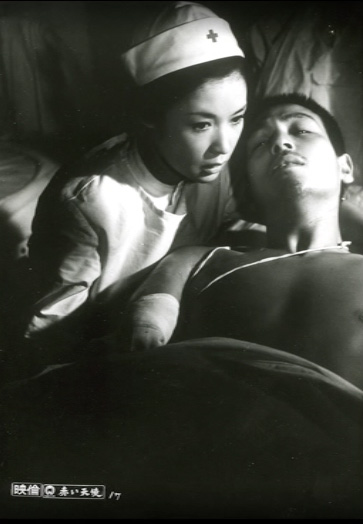
Red Angel doesn't shy away from controversial wartime issues including the harsh realities of triage, comfort women, drug addiction, rape and disease. The film deals frankly with amputation (complete with an extended bone-sawing sequence) as well as the fate of the limbless survivors; according to one armless man (Yusuke Kawazu, right), guys like him would never see their families again (due to the Japanese government's policy of stashing multiple amputees away in convalescent hospitals so as not to expose the dark verities of war). The special care Nurse Nishi provides this poor unfortunate makes Florence Nightengale look like a candy striper.

Director Yasuzo Masumura was attracted to the dark side of human nature (one reason he's a personal favorite); it is an ever-present component of such wildly divergent yet consistently excellent films as Giants and Toys and Black Test Car (corporate espionage); Manji (lesbian love); Blind Beast (ero-guro); A Lustful Man (Edo-period sexcapade); and Yakuza Soldier (Shintaro Katsu as a drafted thug). Masumura studied film in Rome at the Centro Sperimentale di Cinematografia and AD'd under Kenji Mizoguchi. He liked working with Ayako Wakao, casting her in Manji, A Lustful Man, and yakuza flick Afraid to Die.

Back when I acquired Red Angel, it was only available overseas on a region-2 disk. Fortunately for you, the good folks at Fantoma have released it here, along with Blind Beast, Manji, Giants and Toys and Black Test Car. I can't recommend these pictures enough. It kills me to think of all the other Masumura films never released on DVD, but what can you do? Well, you can blog about it and hope the manufacturers take notice.

Saturday, November 14, 2009

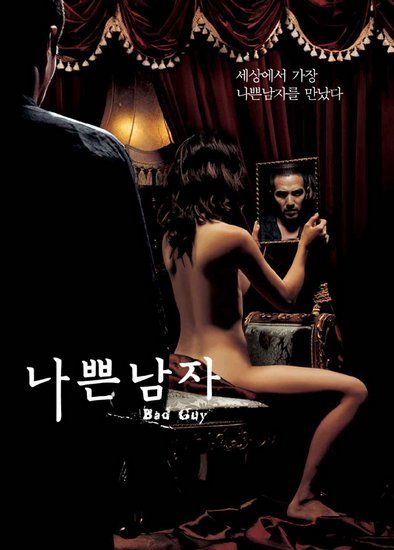
Bad Guy

Having enjoyed a number of films from controversial Korean director Kim Ki-duk (The Isle, Spring, Summer, Fall, Winter... and Spring, Samaritan Girl, 3-Iron, The Bow -- well, actually, I didn't enjoy The Bow), I thought I'd go back and see one I missed, 2001's Bad Guy. I'd initially avoided it because of the storyline: A pimp forces a woman into prostitution. Yawn. However, we're talking Kim Ki-duk here, and it occurred to me that I'd probably underestimated his ability to take a simple story and fill it with nuance and complex emotion. I was right.

So you've got Han-ki (Jo Jae-hyeon), a fearsome tough guy who never says a word (a recurring motif in Kim's films). In his case, it could have something to do with that big, ugly scar across his throat -- sliced vocal cords? (In point of fact, he does say something eventually, but I won't say what.) He takes one look at pretty college student Seon-hwa (Seo Won) and it's all over: Love at first site. However, he's a violent dude with a gangster past, and the best he can think of is to grab her, on the street, in front of her boyfriend and a throng of bystanders, and plant an extended, angry kiss on her lips. Needless to say, this doesn't go down well with anyone, least of all a group of passing soldiers, who insist he apologize to the young lady. Their way of insisting involves beating the shit out of him, but our bad guy ain't talking. Seon-hwa spits in his face and everyone disperses. But does this incident dampen Han-ki's ardour? Not a bit of it. It rather stiffens his resolve.

Han-ki eventually gains total control of Seon-hwa, through a series of machinations I leave to you to discover. And eventually, a relationship of sorts develops between them, even as he watches her turn tricks through a one-way mirror, at one point with one of his own henchmen. It's a strange, dark tale of obsession and degradation, and whether you consider it a misogynist fantasy or a genuine love story, there's no denying Kim's ability to suck you in and hold you, riveted, until the final frame.

Friday, October 30, 2009

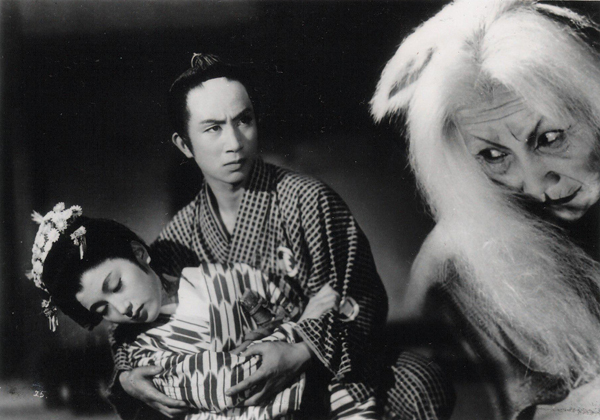
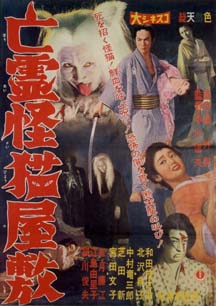
Mansion of the Ghost Cat

This classic Nobuo Nakagawa spooker holds many a key to the J-horror genre of recent years. Notable, that, as it was made in 1958. Many tropes and features of the modern Japanese horror film, considered so unique and cutting-edge by contemporary Western viewers, go right back to Nakagawa (and beyond). Here we have the horrific apparition of the vengeful lady ghost, the elaborate backstory, even the old corpse-in-a-wall revelation (utilized to great effect in the Korean shocker Phone).

Less familiar is the Japanese folkloric tradition of the bakeneko, or "ghost cat." The bakeneko, a demonic shape-shifter, often poses as a human, wreaking revenge on behalf of a dead owner. However, the line between human ghost and ghost cat tends to get somewhat blurred in film, most notably in movies like Kuroneko (see my review in Warring Clans, Flashing Blades) and Demon of Mt. Oe.

In Mansion of the Ghost Cat, a choleric old Chamberlain strikes down his Go master when the young man accuses him of cheating. The Chamberlain proceeds to slay the Go master's mother and grandmother (world-class asshole that he is). The Go master's beloved cat somehow melds with the spirit of his grandmother and proceeds to wreak bloody revenge on the Chamberlain and his kin. But the curse extends to all the descendants of the Chamberlain, and therein lies the connection to the modern-day (late 50s) frame story. Yes indeed, the old granny/cat isn't finished yet ...

Any fan of modern J-horror (and K-horror) owes it to him/herself to check out some Nakagawa pictures. Here's a partial list (although IMDb is always a little dodgy with their Japanese film data). A more comprehensive list can be found here, but you have to be somewhat conversant with the Japanese language.

If you only see on Nakagawa picture, make it Jigoku (Hell). It's on a Criterion release, so you won't have any trouble finding it. You'll just have trouble sleeping later ...

Thursday, October 15, 2009

Two from Tartan

Or rather Palisades Tartan, as the US-based Palisades Media Group has seen fit to resurrect the venerable UK Tartan DVD label (following its lamentable demise last Summer). Why should you care about this? Because of the many great films in the Tartan Asia Extreme catalog including Audition, Battle Royale, Dead or Alive, The Eye, The Happiness of the Katakuris, Hard Boiled, Infernal Affairs, The Isle, Joint Security Area, Marebito, Oldboy, Phone, Ringu, Shiri, A Tale of Two Sisters, Tell Me Something, Tetsuo: The Ironman, Three... Extremes, Triad Election, Versus, and Visitor Q (all of which you should have seen by now).

The good folks at PT were nice enough to send me the first two releases from the revivified Asia Extreme line, so it behooves me to oblige them (and you) with a review. The two titles are P (2005, Thailand) and The Butcher (2007, South Korea).

P
Yeah, I know, I hate the title too. Letters, numbers, they make even worse movie titles than vague crap like State of Play or Away We Go. In this case, P is the name of a particular go-go bar in the Soi Cowboy section of Bangkok. Soi Cowboy is where all the farangs (white foreigners), as well as hordes of Japanese and other Asian guys, go to pay for sex. (Check out a novel called Bangkok 8, you'll spend a lot of time there.)

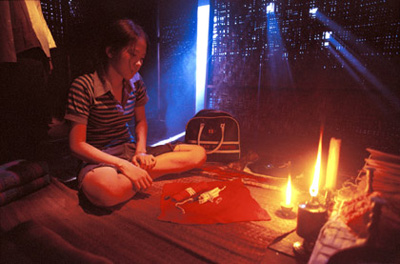
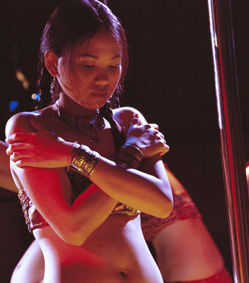
So what's a pretty young thing like Dau (Suangporn Jaturaphut) doing in a place like this? The usual: She's come from the provinces to earn money for her sick grandma back home. She's a virgin and none too pleased with the ugly turn her life has taken. First day on the job, she's turned out by the farang owner of the bar, and, before long, she's dancing and servicing the customers like the rest of the girls. But our little Dau is not your typical country bumpkin-turned-Bangkok-pro. Since childhood, her grandmother has schooled her in the ways of Khmer sorcery, and right about now she's deciding she's had enough, and it's time for others to start suffering ...

Unfortunately, our Miss Dau breaks certain cardinal rules laid down by grandma, and winds up releasing a demonic doppelganger that goes on gory killing sprees while she sleeps. Things get out of control and, well you'll see.

I would categorize this film more as "supernatural drama" than straight-up horror. For one thing, Suangporn Jaturaphut is just too cute to be all that frightening, for all the efforts of the lighting and effects guys. And the tone of the film is more mellow, gentle even, than a horror film should be. This I attribute to writer/director/editor Paul Spurrier, a British former child actor who seems more interested in relationships and cultural resonances than scaring the shit out of you. Which is fine by me -- he does an admirable job, and, once I adjusted my expectations, I found myself really enjoying the picture. But then again, I'm a sucker for Southeast Asia ...

The Butcher
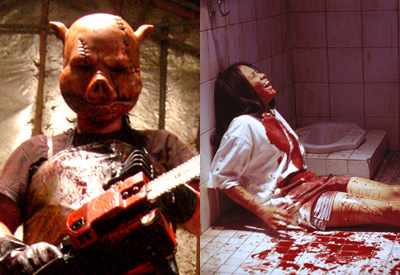
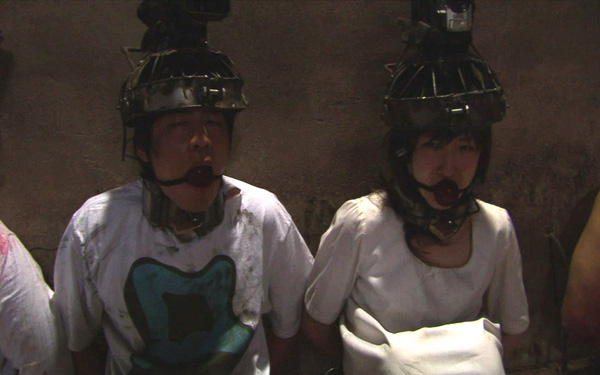
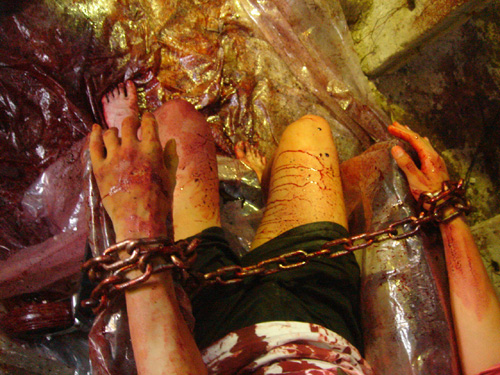
I've said it before and I'll say it again: No wonder real snuff films cost so much -- the fake ones are crap! Or perhaps I'm just not the fake snuff film type. Because as fake snuff films go, you can't really fault The Butcher. Its innovative use of first-person P.O.V. (via a head-mounted camera) puts you in the driver's seat (or rather under the wheels of the car) as the victim of a trio of relentless psychos with cameras (one of whom wears a pig's head the whole movie and squeals accordingly). First you quake with fear as a couple of your fellow victims are dragged away to another sector of the dilapidated industrial compound in which you're being held, only to hear their agonized screams accompanied by the unmistakable sound of a laughing chainsaw. You and your wife are next ...

All sorts of nastiness ensues, and it really is unbearable. Unbearably boring, that is. And annoying. I can only take so much incessant, horrified screaming. I had to turn the volume way down low just to get through it (I don't know how the crowd at last year's New York Asian Film Festival managed it). Here we have methodical violence pushed to it's furthest extreme, and after 75 minutes one hits upon a philosophical truth: Brutality is ultimately mundane. There's nothing particularly inventive about cutting someone's hand off or pulling out their entrails and their eyeballs. Shocking? Sure, but once you get past the shock, where do you go from there? Nowhere, that's where. But hey, that's just me. Like I said, I'm not the torture porn type.

I'll give The Butcher credit for improving on the notorious Guinea Pig movies. This being a Korean film, the ferocity factor is definitely jacked up past the threshold of that Japanese franchise, making the latter look positively sedate in comparison. If you liked the Guinea Pig flicks, you'll likely go gaga for this. I can't say how it might compare with those horrendous August Underground films, of which I've only read in the pages of Rue Morgue Magazine -- I'll leave such decisions to the true gore hounds out there.

According to the press materials, The Butcher will be released October 27th, just in time for Halloween. Good thing, that, because this would be a great film to have on while kids are coming to your door for handouts. All the screaming will create great ambiance, and a glimpse of the screen will surely freak their little worlds. Just hope some concerned parent doesn't pull a Charlie Sheen and call the police!

Tuesday, September 29, 2009

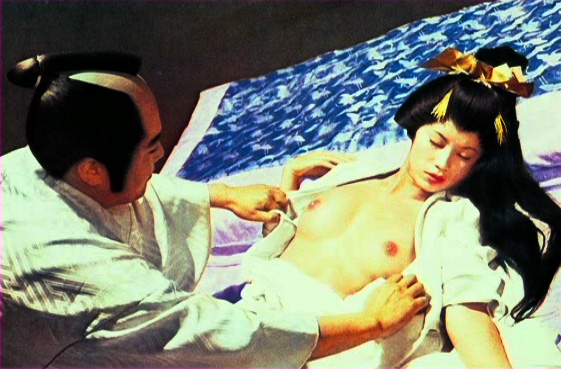
The Lustful Shogun and his 21 Concubines

If you thought Bohachi Bushido was a good example of sexy jidaigeki, have I got a much-better (and sexier) movie for you: The Lustful Shogun and his 21 Concubines. The story concerns a horny shogunal kagemusha (double) who bonks his way through the ooku (royal harem) of Edo Castle. There's ever so much lovely female flesh on display here, along with all manner of inventive sexual activities employing dildos, midgets, paintbrushes, and a talented pekinese. We also meet a tattooed nun, a lady thief and a couple of Chinese eunuchs. But what we get most of is lots and lots of good old fashioned rumpy pumpy. Yes, whatever complaints you might have about this film, "I didn't see enough fucking" will not be one of them. Frankly, I had no complaints at all; laughs, beautiful women, political intrigue, sword action, and every sex position imaginable -- what's not to like? Sure, the whole affair is decidedly softcore -- no full frontal nudity or penetration -- but there's no denying the Japanese pink film genre's determination to deliver everything but.

The film was directed by Norifumi Suzuki, who, together with Teruo Ishii (he directed Bohachi Bushido), churned out some amazing exploitation films for Toei studios during the late 60s/early 70s. But for my money, it is Suzuki who deserves the mantle of superior filmmaker. While Ishii had his moments, his output was uneven in the extreme, whereas Suzuki always delivered consistently well-made and thoroughly entertaining films.

Featured here are Toei's reigning fleshpots of the period, Reiko Ike and Miki Sugimoto (as the lady thief and a hot noblewoman respectively). Then there's the stunning Yayoi Watanabe as Ukiku, the peasant girlfriend of our impetuous impostor (played with enthusiasm by Shin'ichiro Hayashi). Toru Abe is the manipulative minister who set up the whole imposture for his own ends; his wife and virgin daughter are soon defiled by his priapic protege.

I won't pretend The Lustful Shogun and his 21 Concubines is anything more than a panorama of prurient pleasures with some goofy gags and sword fights thrown in, but hey, it's better than 90% of the crap down at your local cineplex, so why not check it out?

Saturday, September 26, 2009

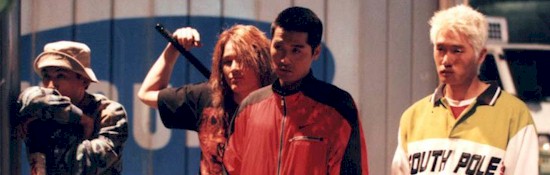
Attack the Gas Station

I often speak of the amazing violence and rage of late 90s/early 00s Korean film, and Attack the Gas Station (1999) is a prime example. While far more light-hearted than something like Peppermint Candy or Sympathy for Mr. Vengeance, this comedy nevertheless exhibits the same explosive quality, a product of nearly a century of political repression.

The story is straightforward enough: Four tough misfits from divergent backgrounds (a baseball player, a rocker, a painter and a formidable goofball) decide to rob a gas station, and wind up staying all night. They've hit this place before, you see, trashing it in the process, and the boss is wise; he's given the day's receipts to his wife, leaving nothing for our petulant protagonists. So they decide to hang around and collect what comes in. Fair enough, but things get complicated, as employees and difficult customers are held hostage, local cops get suspicious, and conflicts develop between the fearsome foursome and a collection of high school bullies, gangsters and scooter-driving Chinese food delivery boys. Tension mounts, and what started out as a simple premise becomes an epic of political allegory and high farce (with tons of fighting, property damage, huge bowls of noodles and bad singing).

Fans of Oldboy will recognize Yu Ji-Tae, the villain of that film, here with his hair dyed white as Paint, the artistic member of the group. The aforementioned formidable goofball is played by the unforgettable Yu Oh-seong, who also turns in a great performance in the poorly-titled yet compelling gangster saga Friend (Chingoo, 2001).

I saw Attack the Gas Station years ago, thought of it quite a bit since and finally bought a copy. I suggest you do the same. You'll love it, plus you never know when this stuff will go out of print. One thing: The dimwits at Media Blasters set the default audio to the English dubbing. Do I have to tell you to switch it to Korean and turn the subs on? Good, didn't think so.

Monday, September 7, 2009

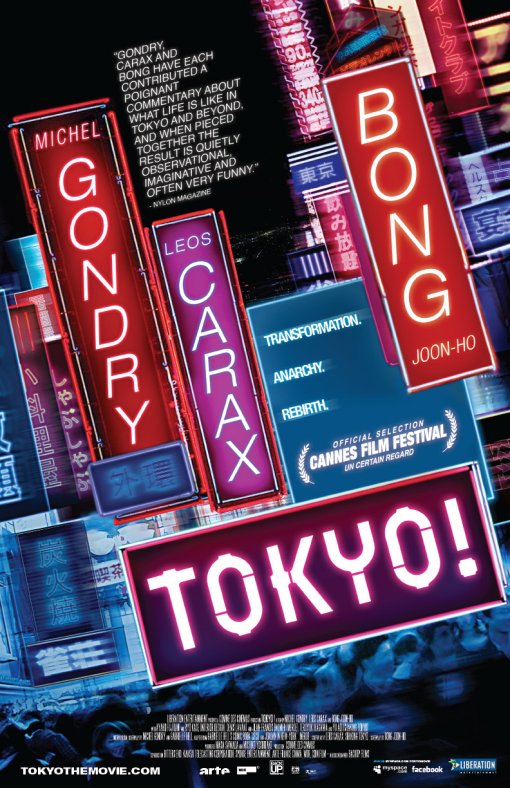
Tokyo!

You'll never forget this guy (above), although his is the least of the three vignettes that make up this cinematic triptych featuring the directorial talents of Michel Gondry, Leos Carax (both French), and Bong Joon-ho (Korean, he who gave us The Host). Manhole boy here is Merde, the so-called Creature From the Sewers (of Tokyo, of course), played with aplomb by the talented French actor Denis Lavant (he was great in 2005's steamy slow burn Wild Camp opposite the very hot Isild Le Besco). We learn more than we ever wanted to know about Merde, and while Lavant's performance is engrossing, it can't overcome the tedious, static tone of the piece.

Better is Gondry's bit. You'll remember him from such films as Eternal Sunshine of the Spotless Mind (2004, so so) and Be Kind Rewind (2008, horrible). (More intriguing to me is Gondry's claim that all his dreams are lucid, and he directs them as he would his films -- I guess I should see his 2006 film, The Science of Sleep). Anyway, his deal concerns a hapless young couple trying to make their way in the big city (that would be Tokyo) until the girl makes a remarkable and unexpected transformation ...

Best is Bong's entry, about a thirty-something hikikomori (shut-in) who falls in love with a pizza delivery girl and learns true values (it's a lot better than it sounds). I'd recommend the film just for this segment -- however it's the last one so you might as well watch the other parts as well.

Keep an eye out for some familiar faces, like Nao Omori, forever remembered as the title character in Miike's Ichi the Killer; Teruyuki Kagawa (Tokyo Sonata, Hana, Sukiyaki Django); and the great character actor Renji Ishibashi (Watcher in the Attic, Audition, Crest of Betrayal, Dora-heita, and many more).

The vignettes are far stranger than I was expecting. Refreshing that, as I was dreading some drab, meandering, mumblecore thing. Only the Bong piece truly utilizes and reflects Tokyo's sense of place -- the French films use it more as a backdrop. But all in all, I'd say I'm glad I saw Tokyo! and feel sure it will appeal to fellow Nipponophiles.