Wednesday, October 10, 2012

Eleven Samurai

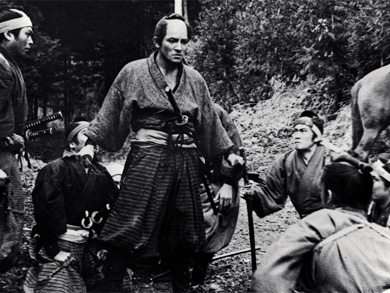
Eichi Kudo's Eleven Samurai rounds out his we're-gonna-get-that-motherfucker samurai trilogy quite nicely. If you liked The Thirteen Assassins and/or The Great Killing, you're gonna love this. Everything is tightened up; where Thirteen Assassins was a bit process-driven and Great Killing somewhat chaotic, here he's got it just right. Pace, tension, carnage -- everything is in perfect balance.

As with the previous films, this is an affair of vengeance. A heinous personage in a position of power has done something awful, and it's down to a small group of highly skilled individuals to make it right. In this case, the culprit is the shogun's brother, a fella named Lord Nariatsu (the irrepressible Kantaro Suga, also the baddie in Thirteen Assassins). Jesus, is this guy wicked (one hapless lord takes an arrow in the eyeball for his trouble). Any chance Nariatsu will lose his head at the end of 100 minutes?

I should pause to praise the look of this film. The B&W cinematography is truly awesome. Something about the Japanese architectural aesthetic blends so perfectly with black-and-white photography -- oh go read In Praise of Shadows already ...

But the cast! To die for. Clearly word was getting around about this Kudo guy. Kotaro Satomi, the main young dude of the other two films, is back, albeit in a tiny role. Also returning is Toei chambara stalwart Ryutaro Otomo (he was the bad guy in Great Killing, but here he's the standup samurai retainer who, because of bushido, has to defend his scumbag lord to the bitter end).

The central revenger, Hayato Sengoku, is portrayed by one of my favorite Japanese actors, Isao Natsuyagi. With his downturned crescent mouth and huge ears, you wonder, "What's this guy gonna give me?" but the sheer presence of the man puts him over the top, makes him a star. I've written about him before (please buy and read my books!). Samurai Wolf, Shogun's Samurai, Bandits vs Samurai Squadron, go check him out, the guy rocks.

And then there's Ko Nishimura, reprising his role in Thirteen Assassins, as a badass master swordsman. Nishimura appeared with Isao Natsuyagi in Samurai Wolf 2, don't you know (don't get me started on Ko Nishimura -- I could go all day). And let's not forget Junko "Quick-Draw Okatsu" Miyazono who was also the blind woman in Samurai Wolf.

Oh, and Kei Sato!

Look, if you're reading this and you haven't seen this picture, you owe it to yourself. It's really quite an excellent samurai film. There was a time I thought Eichi Kudo overrated; I came around. And this, as far as I'm concerned, is his magnum opus. But don't trust me -- just ask Paghat the Ratgirl.
Sunday, October 7, 2012

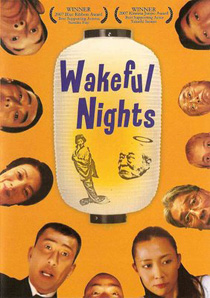
Wakeful Nights

I don't normally review comedies here, because, well you know, the whole Asia Shock thing -- comedies by and large aren't all that shocking. But this one is! Wakeful Nights (Nezu no ban aka A Hardest Night, 2005) features, among other things, the filthiest song I've ever heard in my life (and that's saying something). It has all the elements I like: Black comedy, bawdy gags, a great cast, lovely scenic locations and rakugo.

In case you didn't hit the link on rakugo, it's a traditional Japanese theatrical form that goes back with kabuki and bunraku. It's essentially a comedic monologue, very stripped down (the performer has two props, a folding fan and a hand towel, which he uses to represent a wide range of objects). In Wakeful Nights, rakugo stays mainly in the background; an old master of the art dies, and the members of his troupe hold a wake. This is followed by more wakes, as other members of the group proceed to expire (hence the pun on "wakeful" in the title).

Hats off to my friend David Rowe-Caplan who translated this (and many another) film for Animeigo. He's the guy who comes up with all that onscreen gloss to explicate linguistic difficulties in the subtitles. He sure had his hands full on this project. He told me it was the hardest subtitling job he's ever had to do because of all the Japanese puns he had to explain. Add to that the fact that the puns are mostly obscene, and you begin to understand his conundrum; it's hard enough to get across subtle shades of meaning, but how do you subtly explain a pussy joke?

And there's a ton of pussy jokes on offer. And dick jokes. And shit jokes. The stuff people say in this film is as outrageous as the stuff they do. Be warned, however, it starts off a little slow with an extended death bed scene (albeit brightened by a last request for one final gander at a "honey pot" … ).

The ensemble cast is pitch-perfect. If you've seen a lot of Beat Takeshi films, you'll recognize baggy-eyed Ittoku Kishibe as the son of the rakugo master (nice to see him in something other than a dour, underworld persona). Then there's Kiichi Nakai -- he was the country bumpkin ronin who somehow wins the battle of Toba-Fushimi single-handedly in When the Last Sword is Drawn (2003, see my review in Warring Clans, Flashing Blades). Then of course there's Hiroyuki Nagato who plays the old master. He's been kicking around since the 50s, appearing in films like The Warped Ones, Pigs and Battleships, The Insect Woman, Bandits vs. Samurai Squadron and over 100 more.

Wakeful Nights is also notable for being the directorial debut of Masahiko Tsugawa, grandson of legendary silent film director Masahiro Makino and prolific actor in his own right. He got his start in sun tribe films like Crazed Fruit and The Sun's Burial and has been working consistently ever since (he played Shingen Takeda in samurai epic Heaven and Earth -- see my review in Stray Dogs & Lone Wolves).

So my advice to you is absolutely check out Wakeful Nights. If you're like me and have a somewhat sick sense of humor I guarantee by the end you'll be howling!

Friday, September 28, 2012

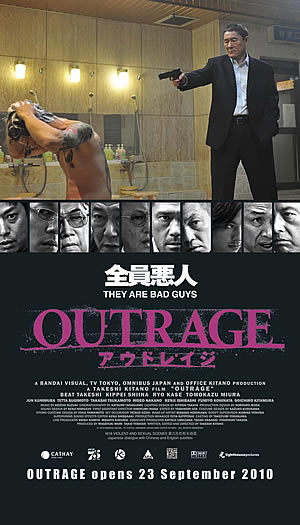
Outrage

A couple of years ago "Beat" Takeshi Kitano returned to the yakuza genre, writing, directing and editing Outrage. I have to admit I was excited; Violent Cop, Boiling Point, Sonatine, Fireworks -- the guy's made some fantastic yakuza pictures. I also have to admit that I was a little disappointed with Outrage.

To its credit, the cinematography and production design are immaculate. Outrage is a gorgeous film to look at. However, the old vibe is gone. Kitano's 90s films had a trademark Zen calm, punctuated with short, sharp shocks of ultra-violence. Here, the former has been dialed way down and the latter way up. Don't get me wrong, I have no problem with ultra-violence, when it's called for. However, the Grand Guignol portions on offer here seem a bit overdone, as if the old outrager had become unsure of his game -- after so many years of being outrageous, he appears to have lost his balance, his deft touch gone all ham-fisted.

The story involves an internecine squabble between two yakuza groups that spirals out of control, causing lost pinkies, dental torture and, ultimately, mass carnage. Poor old Renji Ishibashi (Ronin-gai, Audition, Crest of Betrayal, Dora-heita, tons more) gets the worst of it, having the misfortune to be in the dentist's chair at the wrong moment. Beat Takeshi's character is the loyal lieutenant manipulated by his boss and higher ups into essentially destroying himself (by way of destroying others). You could say he was only following orders, but that's turned out to be not such a good defense …

Don't get me wrong, Outrage is not a bad movie. In fact, compared to most of the crap coming out these days, it's damn good. I'm only comparing it to it's predecessors. Beat Takeshi set such a high bar that his toughest competition is himself. No artist wants to admit it, but they all have an arc; they reach the peak of their creative potential and come back down. Rarely do they get a second one. Outrage is a Beat Takeshi film on the downside of the arc. Far from the bottom of the chart, I should add.

So should you see it? If you're a Takeshi Kitano fan, I'd say definitely. It's good to see the old boy again, slapping people around, shooting them and generally causing mayhem. If you like Japanese film and want to see Tokyo in all its gorgeousness, another reason for a look see. For those more sensitive souls (who probably aren't reading a blog like this), I'd advise a pass. Outrage is a brutal film about brutal men doing brutality. On the other hand, if that's your thing, tuck in!

Wednesday, September 26, 2012

The Warped Ones

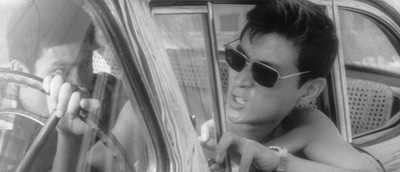
Meet Akira (Tamio Kawaji). He's young, handsome and a total scumbag. For one thing, he's a thief. Good lord, there's nothing this kid won't steal! He'll pick your pocket, hot wire your car, even your morning milk and newspaper aren't safe. He'll also rape your girl …

And yet somehow you can't take your eyes off him and, inexplicably, help but be squarely in his corner. Such is the jazzy, delirious charm of Koreyoshi Kurahara's The Warped Ones (1960). It's like Oshima's Cruel Story of Youth (of the same year), yet grittier and more slick at the same time. It's a 75 minute thrill ride through the mean streets of Tokyo that will leave you breathless, exhilarated, and perhaps a little ashamed at having enjoyed yourself this much.

These days Seijun Suzuki gets the lion's share of 60s Nikkatsu cult cred, but Koreyoshi Kurahara, while lesser known in the West, is right up there, a vital, visceral powerhouse of a director (and a not inconsiderable seat-filler in his day). He came up in the 50s working on taiyozoku-eiga (sun tribe films). He was the AD on the most excellent Crazed Fruit (1956), starring white hot husband-and-wife team Yujiro Ishihara and Mie Kitahara, and made his directorial debut with the same couple in the compelling noir I Am Waiting (1957). Kurahara went on to span multiple genres and find success throughout the remainder of the 20th century (watch this space for more reviews of his work).

If for no other reason, I encourage you to see this film for the performance of Tamio Kawaji. For one thing, you'll never see this much mugging in your life. Man, what a mobile face! This guy gets off more puckers, fleers and grimaces in five seconds than most people do all day. And his body language is just as expressive; it's as if the director wanted him to embody the whole of post-war Japanese youth angst -- and he does! Kawaji's performance is a seething, writhing, febrile exercise in total chaos not to be missed!

I don't know if it's worth mentioning, but Koreyoshi Kurahara's brother also worked for Nikkatsu, albeit after the changeover to Roman Porno in the 70s. I reviewed one of his films, Eros High School: Feels So Good, on this blog (hey, what can I say, they send me these things).

What is worth mentioning is that you can get The Warped Ones, along with a number of other Koreyoshi Kurahara films, in a box from Criterion (Eclipse Series #28). I always advise acquiring such things, because when the grid goes down, only us lucky devils with a a solar panel and lots of disks will be sitting back, enjoying Japanese film! Step off you zombies, I've got a katana!!

Thursday, September 20, 2012

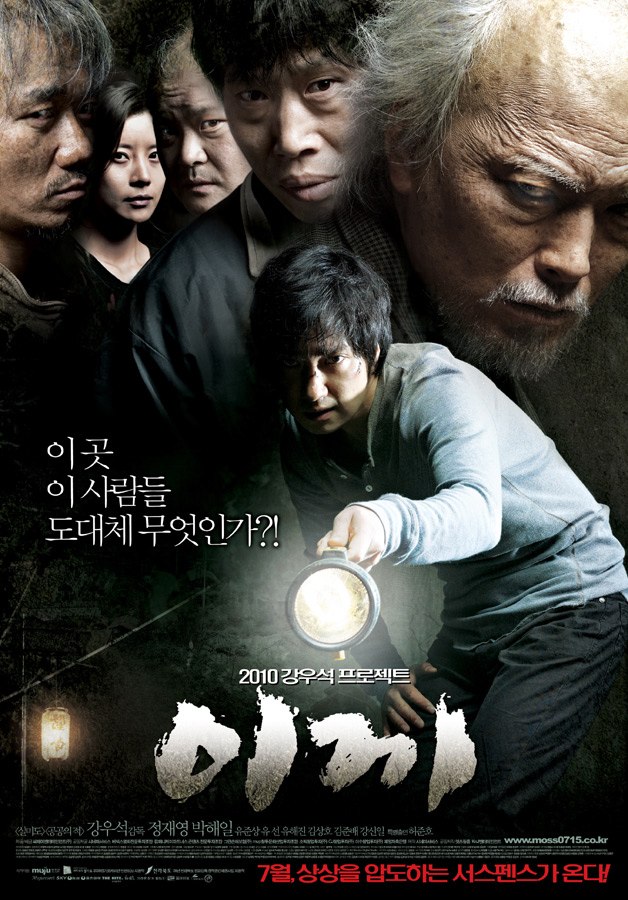
Moss

Here's a classic example of the WTF? Where is this going?-type Korean film that nevertheless sucks you in. And once you figure out what's going on, it completely sucks you in. Not without it's problems, it's the kind of film where you only realize the problems later, as you're digesting this nearly three-hour mini-epic of corruption, redemption, Christian violence and revenge.

Moss (2010) is based on a remarkably cinematic online Korean manga by Yoon Tae-ho, parts of which you can see here. Flicking through it, you realize how faithfully the film follows the frames (although there are several major alterations). That's why so many comic books and graphic novels are adapted to film: Everything is storyboarded out. Makes things really easy for the filmmakers.

In broad strokes, the story is an allegory of how corruption co-opts religion. Of particular interest to me was the fact that it was set in a rural village far from Seoul -- dark doings are always so much darker in the lush greenery of the countryside. Anyway, an elderly, Christ-like man dies of mysterious circumstances, and subsequently his prodigal son shows up in the village to get to the bottom of things. And boy is there a lot to get to the bottom of! The backstory spans 25 years and includes generous portions of depravity, arson, rape, mass murder, police corruption and, of course, lots of stabbing. I don't mean that in a bad way …

As I mentioned, there are problems. The denouement goes on a bit, and some issues are never made quite clear (but I suppose you get that when adapting a ridiculously rich and complex story). And there are the implausible moments that work better in a manga than on film, like when the young protagonist is repeatedly brutally stabbed in the belly and manages to run around the woods, eluding and even dispatching his attacker, all with a hand holding in his guts. Yeah right! But then this is a Korean film, with all the visceral grip we've come to know and love.

I'd definitely recommend Moss to anyone interested in Korean cinema. There are some really brutal scenes at the outset, but don't let that turn you off. By the time the final credits roll, you'll feel like you've been through something. Something major. That's what I love about Korean films of this genre: They put you through the fucking ringer. Total catharsis! Film can't do much more than that.

My thanks to Dr. Stan Glick for turning me on to this film.

Sunday, September 9, 2012

Pat in NYC


Not so shocking, but certainly Asian-themed was my recent visit to New York City (over Labor Day weekend). Friday night I had dinner with this maniac, Ric Menello (left). He directed rap videos for Rick Rubin back in the 80s (Fight for Your Right to Party, Goin' Back to Cali, and others); more recently he's writing screenplays (co-wrote Two Lovers, a James Gray film starring Joachin Phoenix). And of course he's a Japanese film fanatic. He contacted me after my first book came out in 2005, and we became fast e-pals. In more recent years, I've had a couple of opportunities to get together with him in NYC.


We had a great time at Kenka, a funky, atmospheric Japanese joint in the East Village. Insanely huge menu that occasionally went to extremes (anyone for bull penis? No? How about turkey testicles?). We were joined by my lovely wife Shirley and Ric's best friend Mel Neuhaus (both of those guys are walking film encyclopedias, so you can imagine it was a food and film orgy extraordinaire!).


What I particularly appreciated about Kenka was its Japanese film theme. There are old samurai film posters everywhere, big head shots on the wall by the bathroom (while you wait, see how many stars you can identify!). And the piece de resistance is the striking Ken Takakura mural on the back wall. Talk about my kind of place!  


Then on Saturday I had lunch with world famous Asian film expert Dr. Stan Glick. We ate at New Wonjo, an excellent Korean joint on the bit of W. 32nd Street known as Koreatown (between 5th and 6th Avenue). Stan and I had bibimbap and assorted appetizers (fish pancakes, veggie egg rolls, etc.) and I drank a lot of sake (go figure). Forgot to take pictures, but remembered at the last minute in front of a Nathan's where we utilized the advertising for our own corny purposes.


Wednesday, September 5, 2012

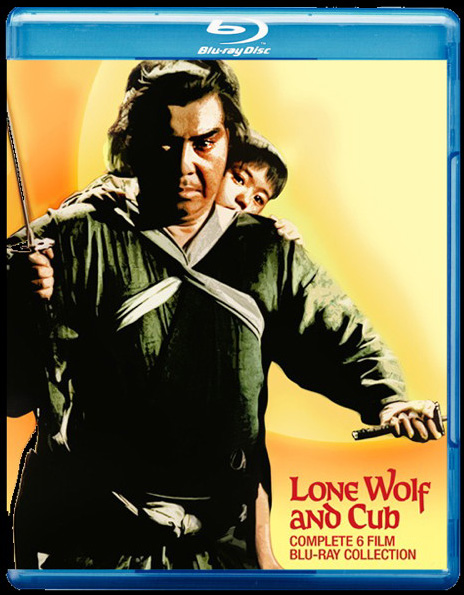
Lone Wolf & Cub on blu-ray

The one thing I've always pointed out about the Lone Wolf & Cub films, beyond the mind-bending martial arts and geysers of blood, is the fact that they are exceptionally well made films, capturing and utilizing the natural beauty of a wide variety of Japanese landscapes; forest, desert, ocean, grove -- the color and clarity of the nature imagery contrasts and enhances the dark doings of the human dimension.

So you can imagine my excitement at AnimEigo's release of the entire six-film series in a two-disk blu-ray pack. Man, those colors just POP! If any film series could be improved by a blu-ray release, this is it.

Now I hear you saying, "Aw jeez, times are tough, and I already have these films on DVD. Do I really need 'em on blu-ray too?" Yes. Yes you do. I'm telling you, I've probably seen these films more than you, but they have a timeless quality -- they never get old. So if you're going to be watching them for the rest of your life, don't you want the best looking copies available? Plus you get the industry standard AnimEigo features: Excellent subtitles, subtitle gloss to help you understand Edo-period terminology, as well as comprehensive film notes featuring a wealth of historical background. With this collection and my books, you'll be in samurai hog heaven!