Monday, June 28, 2010

JAPAN CUTS at the Japan Society NYC

Hey all my East Coast homies, starting Thursday, July 1st it's the fourth annual JAPAN CUTS Festival of Contemporary Japanese Cinema at the Japan Society, the largest showcase of contemporary Japanese film outside Japan. Special guests include filmmakers Momoko Ando, Noboru Iguchi, Yoshihiro Nishimura, Tomorowo Taguchi, Toshiaki Toyoda, Hitoshi Yazaki, Isao Yukisada, and actors Tatsuya Fujiwara and Daichi Watanabe.

Films to be screened include Confessions (dir. Tetsuya Nakashima), Sawako Decides (dir. Yuya Ishii), About Her Brother (dir. Yoji Yamada), Blood of Rebirth (dir. Toshiaki Toyoda), Bare Essence of Life: Ultra Miracle Love Story (dir. Satoko Yokohama), Dear Doctor (dir. Miwa Nishikawa), Golden Slumber (dir. Yoshihiro Nakamura), Nightmare Detective II (dir. Shinya Tsukamoto), Parade (dir. Isao Yukisada), and Zero Focus (dir. Isshin Inudo).

Great chance to get right up to the minute with Japanese film and yet another reason to be in Manhattan!

Tuesday, June 15, 2010

Green Fish

I've been working my way backwards through the filmography of Korean novelist and director Lee Chang-dong. A couple of years ago I saw his then-latest film Secret Sunshine (2007) in San Francisco and was properly blown away. More recently I screened Peppermint Candy (1999), another triumph. And just now I've seen his directorial debut, Green Fish (1997). Remarkably, that amounts to the majority of his output; he's only made five films in the last 13 years. But if the other two films are as good as the ones I've seen, he can take all the time he wants. His stuff is worth the wait.

Green Fish follows the progress of a young guy named Mak-dong (Han Seok-kyu) from newly-discharged soldier to low-level gangster via an encounter with a mysterious beauty on a train (Shim Hye-jin). She's a singer in a nightclub owned by local gang boss Bae Tae-gon (Moon Seong-guen), whose moll she is, but she's also got a thing for Mak-dong. If all this is starting to sound somewhat film noir-y, it is. What makes the film remarkable is its utterly unpretentious realism. Such a seemingly hacky set-up works because Lee Chang-dong roots his characters and situations firmly in terra firma, employing a style you could call verite noir. As with his other films, Lee isn't so concerned with conventional story-telling as with direct, visceral human experience. This leads to an unpredictability in his films; standard tropes do not concern him, only raw emotion (and a certain measure of social commentary). But since most films are simply a series of surprises anyway, Lee's approach works, albeit from a completely different direction. The audience's cinematic expectations are thwarted by the rude intrusion of something unexpected that might actually happen.

So, for example, when Mak-dong's brother gets pulled over by a cop, he tries to bribe the cop ... and the cop takes the bribe. Mak-dong's brother only has one large bill and asks the cop for change. The cop agrees, then gets in his car and drives away. So crazy brother chases the cop, demanding his change! Elsewhere an imposing thug from a rival gang bumps into Mak-dong in a store, causing him to drop his groceries. The thug picks them up and apologizes ... in English! Then, moments later, he returns with his cohorts to beat the shit out of Makdong and his pals. Green Fish is filled with moments like these. Things inevitably ratchet up but, again, not in the way you might think, and the film ends on a decidedly unconventional note.

One more reason to see Green Fish is the presence of the incomparable Song Kang-ho (The Host, Sympathy for Mr. Vengeance, JSA, The Quiet Family, Thirst), here playing one of Mak-dong's fellow gangsters. It's an early, small role for Song, but his manic energy is in full force -- any time he's on the screen, you can't take your eyes off him. He would team up again with Han Seok-kyu in the taut political/crime drama Shiri (1999).

Green Fish won the Dragons & Tigers Award at the 16th Vancouver International Film Festival.

Friday, June 11, 2010

They can't all be good ...

Contrary to appearances, I have not been neglecting this blog. I have, in fact, been screening films to write about, but they've all been too sucky or non-shocking to qualify. But then I thought, "Hello, why not write about them anyway?" As Groucho Marx once remarked after a particularly crap joke, "They can't all be good, you've got to expect that." You said it, Groucho!

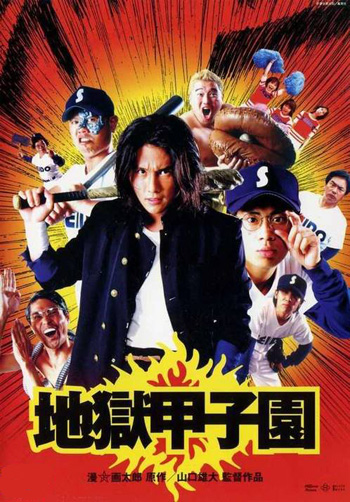
The lamest of the lot by far was Battlefield Baseball (2003). I'd wanted to see this one for years, having heard it was similar to Shaolin Soccer (only with Japanese zombies instead of Chinese martial artists and baseball instead of soccer). Plus Tak Sakaguchi is in it, and I thought he was great in Versus. Imagine my disappointment, then, when I discovered it was utter dogshit. Seriously, I'm willing to forgive a lot in terms of outrageous, manga-esque excess (see my Asia Shock for ample proof), but this film didn't even deliver on the promise of its own outrageousness.

The premise, wafer-thin as it is, is this: A high school principal fears for his prize baseball team when he realizes they're slated to play another team known for mutilating and murdering their opponents on the field. That's it, that's the whole movie. Apparently, the film's budget did not allow for special effects, as all such mayhem happens off screen, leaving us to view a baseball field strewn with cheap-looking body part props. To keep things going, people come back to life, only do the same schtick all over again. Ugh.

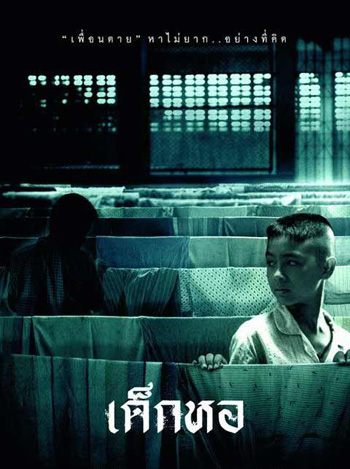
Then I watched Dorm, (2006) supposedly a Thai shocker about a haunted dormitory in a boy's boarding school. Part The Devil's Backbone, part The Sixth Sense, the film isn't bad, in fact it has a gentle charm that infuses what amounts to a supernatural coming-of-age picture wherein a living boy and a ghost boy help each other and those around them. But it sure ain't scary or even remotely shocking.

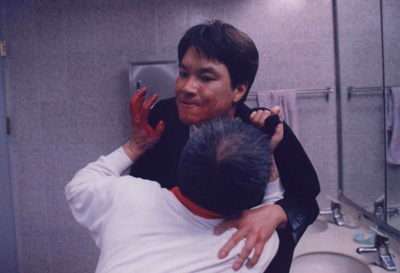
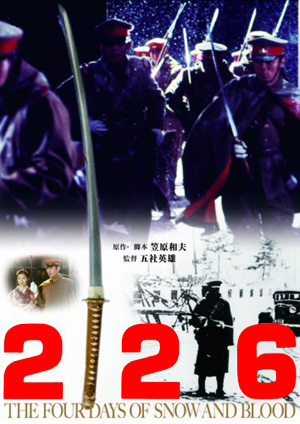
So I decided to throw on a Hideo Gosha film, Four Days of Blood and Snow (1989), about the notorious "226 Incident" that occurred February 26 (hence 226), 1936, in which a group of young Imperial Japanese Army officers attempted a coup de e'tat. Knowing Gosha's visceral style and reputation for brutally realistic screen violence, as well as his string of just-plain-awesome samurai and yakuza films from the 60s and 70s, I figured it was a slam dunk. Gotta be great, right?

Nope. Sadly, whatever Gosha had in 1969 (when he made both Goyokin and Tenchu), he'd all but lost 20 years later. Outside of a thrilling sequence early on, in which the rebellious young officers run around Tokyo assassinating government officials, the rest of the film is just a tedious bore, suffering as it does from the same problem that plagues most films coming out today: No character development. The half dozen leaders of the coup attempt are flat, flat, flat. We are expected to just hit the ground running with these guys without any background, a bunch of wooden toy soldiers spouting the usual nationalistic banalities. Who cares? Wanna know how to make an ensemble piece set in wartime work? Try Paul Verhoeven's The Soldier of Orange.

So now I'm on to the next film. Never fear, dear reader I'll find something good for you. It is my quest, my raison d'etre (and, usually, something I enjoy -- here's hoping I have better luck with Green Fish).

Saturday, May 29, 2010

The Blind Menace

Well, it's happened again: A rare film I had to beg, borrow and steal to secure a copy of has now, once again, been released by a major distributor. This always fills me with conflicting feelings: pissed off that I had to work so hard for something now widely available, yet gratified that others will have no problem enjoying this fine film.

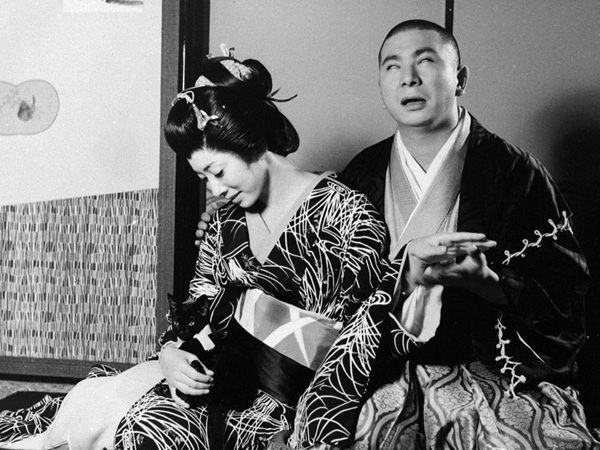
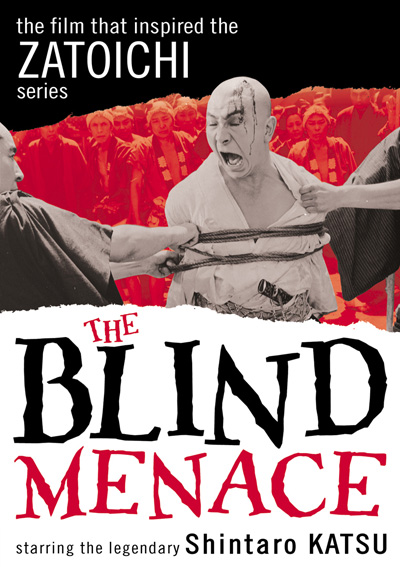
Such a film is Shiranui Kengyo (1960), available now from AnimEigo as The Blind Menace. I wrote a review of this film in my book Warring Clans, Flashing Blades, from which I will now lazily quote (what, I gotta come up with original blog content for you? Buy the damn book, already!). The central character is a man named Shichinosuke, "a sinister, scheming blind masseur played with dark exuberance by the incomparable Shintaro Katsu. Shiranui Kengyo was the first film to showcase Katsu's unique blind man act (somewhat more exaggerated here), but this anma is the polar opposite of the actor's most celebrated sightless characterization, Zatoichi. Shichinosuke, rather than wandering from town to town, gambling, giving massages and protecting the innocent, is more inclined towards thievery, rape, extortion and murder, all employed in the service of his ruthless rise to the top."

Elsewhere I write, "Released in 1960, the film was an instant hit, elevating Katsu to full-fledged movie star. The film's success rested largely on Katsu's brilliant performance as a vile, Richard III-like villain. Like Richard, Shichinosuke's handicap fuels his rage and ambition to rise in a world where the deck is stacked against him, relishing the liberties his treachery allows him with those in the sighted world, particularly the ladies."

Then, toward the end of the review, I say: "Simply put, if you're a Shintaro Katsu fan, you have to see Shiranui Kengyo ... it's one of those holy grail pictures, not necessarily a samurai film proper, but nevertheless essential to aficionados of the genre." (Say, this guy's good!)

If I were you, while you're on Amazon buying a copy of The Blind Menace, I'd also pick up a copy of Warring Clans, Flashing Blades. Then, when that stuff arrives, go get a six-pack, kick off your shoes and get ready for a good ol' Japanese film nerd-out time. You're welcome.

(The Blind Menace streets June 15th, 2010.)

Wednesday, May 26, 2010

Robogeisha

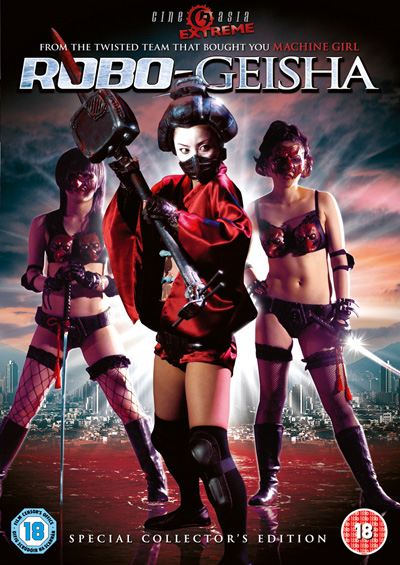
She's a robot. She's a geisha. She's ... well, you know. Written and directed by Noboru Iguchi, the guy responsible for Machine Girl (as well as less-than-memorable titles like Doctor's Enema and A Larva to Love), Robogeisha is essentially a live-action cartoon aimed squarely at the 10 to 14-year-old demographic. This wouldn't be a problem if Iguchi were talented enough to bring out the 14-year-old in me (it's not that hard, I have to say).

Unfortunately, he isn't. Every performance is so exaggerated, every gag so overdone that one can't even lose oneself in the outrageousness of it all -- the film is too busy trumpeting its own outrageousness. Literally. Someone gets fried shrimps jammed into their eye sockets. Immediately the victim screams, "Oh! She jammed shrimps in my eyes!" Or a bionically modified girl shoots half a dozen shuriken out of her ass and the guy who gets them in the face makes a similar announcement. It's as if the director isn't sure you're getting it, that you can't possibly process what just happened (because, of course, it's SOOOO outrageous), that it has to be announced after the fact. This happens continuously throughout the picture.

Don't get me wrong, the gags are indeed outrageous, and often quite inventive. Swords lunge out of womens' mouths and armpits; geisha wigs are tricked out with "wig nepalm;" girls shoot bullets from their breasts, as well as "milk from hell" (which, of course, melts peoples' faces off); one robogeisha projects a circular saw from her mouth with which to murder a prominent politician. Done a bit more deadpan, this stuff might have worked (or at the very least worked better). As it is, it all plays like a twisted, bloody take on a Saturday morning kid's show.

But hey, that's just me. You may indeed be thinking, "twisted, bloody take on a Saturday morning kid's show? I'm there!" In my case, I tend to enjoy OTT antics in films, and if you know me (or if you've read any of my books), you know I'm no snob. The bone I'm picking with Robogeisha is purely a matter of presentation. With a little more work, it could have been a campy romp, instead of what amounts to a mad dash from one jaw-dropping set piece to the next.

So you tell me. Am I being too hard on Robogeisha? Am I just some old fart who doesn't get it? Give it to me straight, folks, I can take it.

(Robogeisha streets June 7th in the UK courtesy of Cine Asia.)

Sunday, May 23, 2010

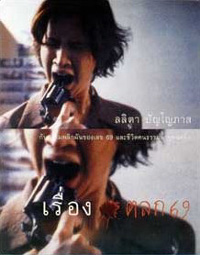
6ixtynin9

Gimme a black comedy where bodies stack up faster than they can reasonably be disposed of. Now make it in Thailand and populate it with a cast of hilariously quirky characters. And, if you must, give it a dumb-ass title.

That film is Pen-ek Ratanaruang's 6ixtynin9 (1999). And before you ask, no, the film has nothing to do with the sex position. It refers to a bit of confusion caused by a 6 on an apartment door that keeps flopping over to become a 9. Clearly the much-better (and Hendrix-referencing) title "If 6 were 9" never occurred to anyone. However, what did did come of Mr. Ratanaruang's efforts is a tasty, twisty Thai take on Danny Boyle's Shallow Grave (1994).

Tum (Thai soap star Lalita Panyopas) finds a box of money on her doorstep. As we all know, this means trouble. Tum's not exactly what you'd call a tough customer, but she nevertheless possesses some impressive survival instincts. Plus she's just been canned from her job and could really use the cash. Therefore when the inevitable thugs show up to retrieve the loot, they get more than they bargained for, setting off a chain reaction of murder and mayhem.

Now you might be thinking, "Oh brother, been there, done that." But you haven't. Pen-ek Ratanaruang was one of the originators of the Thai film boom of the late 90s and is known for his unique style, applying inky black strokes of comedy with a light, deft brush, creating a vibe I'd call "Thai/indy." 6ixtynin9 is more kinetic and plot-driven than his most well-known film, the moodier, dreamier Last Life in the Universe (2003).

As mentioned earlier, the film is made memorable by its wonderful assortment of kooky characters, each played to a naturalistic perfection by the talented cast. Tum's nosy neighbor Pen (Sirisin Siripornsmathikul) is a hoot, a Thai cougar who's having it off with a young cop (uh oh). She always turns up at the wrong moment and at one point has a hilarious discussion with her cronies as to what to do with an inconstant lover (hint: It involves a knife and a food processor ... ). Tum is also forced to deal with the drama queen antics of her friend Jim (Tasanawalai Ongarittichai), a beautiful girl who's unlucky in love and ready to open a vein over it.

But I've said enough. If you haven't seen that many Thai films, I'd definitely recommend this one. If you saw Last Life in the Universe and found it dull, try 6ixtynin9. Thai-flavored black comedies don't get much better.

Friday, May 21, 2010

Accident

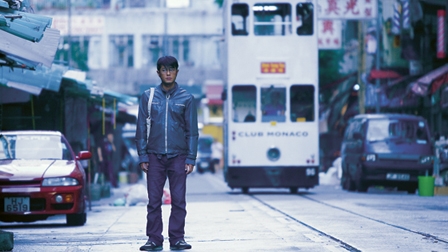
Remember Harry Caul, Gene Hackman's character in Francis Ford Coppola's The Conversation (1974)? Well imagine Harry and his team decided to go beyond mere surveillance and actually worked as a hit squad, murdering people by way of elaborately planned and untraceable "accidents." Now imagine Harry and his guys are Chinese and you've worked your way around to the inventive psychological crime thriller that is Accident (2009). Produced by Johnnie To and directed by Cheang Pou Soi, Accident blends the narrative arc of a heist film (big job goes horribly awry) with the paranoia and meticulousness of The Conversation, throwing in enough twists and turns to keep you guessing throughout.

The crew: Brain (Louis Koo, above), Fatty (Lam Suet), Uncle (Stanly Fung), and, for want of a character name, Hottie (Michelle Ye). They're good. Very good. We see a bit of their handiwork in the opening sequence, wherein they maneuver their target into "accidentally" offing himself. In public, in broad daylight (and quite bloodily, I might add). Later, Brain is upset because Uncle left a cigarette butt at the scene. Yeah, he's that anal. But I guess you have to be in his line of work. Soon they're on to the next job, and it's here that the well-oiled machine begins to break down. Plus, it looks like another faux-accident hit squad has set their sights on Brain ...

Director Cheang Pou Soi worked under Johnnie To as an assistant before donning the director's cap some ten years ago, and while there's a confusing moment now and again, Accident nevertheless delivers the goods as a more cerebral, insular and subtle Hong Kong crime film than you might expect. Recommended.