Tuesday, July 13, 2010

Triangle

Triangle (2007) is an engaging caper flick concerning three Hong Kong losers. It's directed by three great Hong Kong filmmakers: Wong Kar Wai, Ringo Lam and Johnny To. Oh, and among other things, there's a love triangle. So you've got a triangle of triangles, as it were. And, just for good measure, there are some triad guys running around as well. Guess it's true what that redneck Schoolhouse Rock singer sang, "three is a magic number."

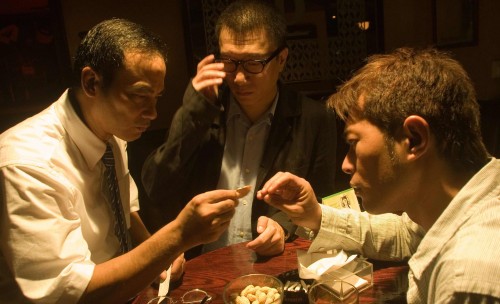
The three losers are: Lee Bo Sam (Simon Yam), a creepy businessman who may or may not have killed his first wife; Fai (Louis Koo), a flaky cabbie who's in hot water with some local gangsters; and Mok (Sun Hong Lei), a knowledgable yet taciturn antique dealer. They unearth a Tang dynasty coffin wherein they find the film's MacGuffin, a garment made of gold coins worth millions. Also chasing the treasure is a local cop (Lam Ka Tung) who's having it off with Lee's neurotic second wife Ling (Kelly LIn) -- they gum up the works considerably.
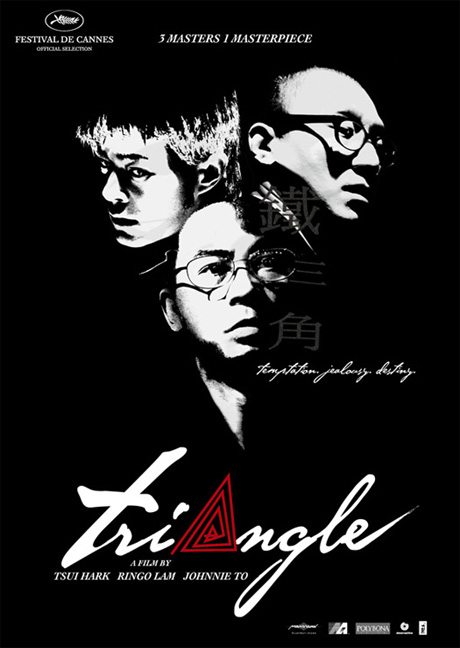
But the creaky plot isn't what's good about Triangle. It's really more of a character study, and a good lesson for any young filmmaker learning how to establish strong characterizations on the fly. Economical yet effective dialog plus top-notch acting puts us on intimate terms with the three principles almost from the get-go. Also fun, of course, is observing how the three directors handle their segments (Wong has the first third, Lam the second, and To the third). Wong's bit features a lot of daytime and exterior shots; Lam goes a bit darker and more emotional, turning the tables on the audience in regards to Lee Bo Sam, the most enigmatic character of the piece (played to perfect pitch by the great Simon Lam); by the time Johnny To gets the reins, it's all about darkness and night, with a grand finale in which the lights go out again and again …

I find pictures like Triangle, where the three directors share the same story, far more interesting than when each get their own vignette; things can go so far afield in the latter scenario, it often feels like three different short films. Here, the filmmakers are forced to work together while still imparting their own individual styles. (If you appreciate this as well, I suggest you check out the American indy horror flick The Signal.)

So there you go: Great directors, great cast, great fun.

Friday, July 9, 2010

Mystics in Bali

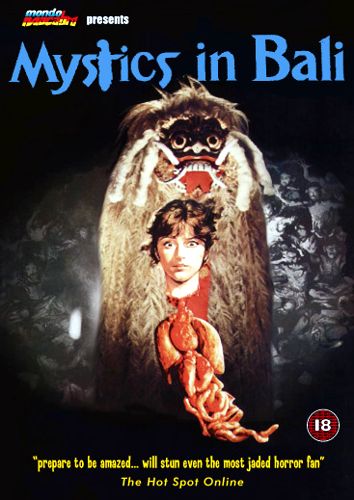
I wish I had seen the Indonesian horror classic Mystics in Bali (1981) when it came out. I was a teenager then and would have appreciated it more -- certainly wouldn't have noticed the cheesy special effects as much, and would have just reveled in the craziness. Coming to it late now, especially after reading about it in Pete Tombs' Mondo Macabro and elsewhere, and having imagined the big scene where the girl's head detaches from her body and flies around with vital organs in tow, well frankly it's a let-down. They achieved the effect in two ways: first, the separation itself, a very primitive optical printer job with the actress's real head, and then a prop head w/guts on a wire. The latter was by far the better effect; you couldn't see it very well and it zipped through the night air with a flair -- much like the real thing, one would imagine.

And make no mistake, out in the provinces, those villagers really do believe in that stuff. Some go so far as to place thorns around their windows so as to snag on the hanging entrails, should one of these floating monstrosities ever try to venture in. The most shocking scene in the film involves just such a home invasion, the head making a meal of a newborn baby as it's coming out! Of course we only get a mother's-eye view which, if you didn't know better, looks rather like a bit of disembodied head cunnilingus.

And whose head is this, anyway? It belongs to pretty Cathy Kean (Ilona Agathe Bastian), a writer from the US who's in Bali doing research on the practice of leak (pronounced LEE-AK), supposedly the world's most powerful form of black magic. With the help of the suave Mahendra (Yos Santo), she meets the leak queen and gets more schooling than she bargained for. And, of course, she becomes the evil queen's slave.

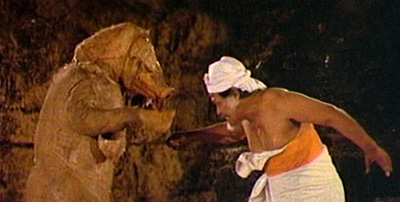
I realize it's ridiculous to complain about the special effects (as well as the crap acting and general cheapness of the production). I'm sure, considering the state of Indonesian cinema at the time, Mystics in Bali was probably considered fairly cutting-edge. I'm obviously reacting out of self-hype, that process where you build something up in your head to the point where nothing can come close to it. In fact, the film has a funky charm and I'd recommend it to anyone who wants to venture beyond the realm of good taste and proper production values and get down and dirty with some jungle sorcery. Certainly the scenes where women transform into snakes and pigs are a scream -- at one point the leak queen gets stuck halfway, jumping around and fighting as a pig-woman with pendulous pig tits! Yes, it's a unique film experience, there's no denying it -- just make sure to keep you expectations set on "low."

Wednesday, July 7, 2010

The Foreign Duck, the Native Duck and God in a Coin Locker

The Foreign Duck, the Native Duck and God in a Coin Locker (2007) had its North American premiere last night at the Japan Society in New York and I was lucky enough to see it. I wish I could say I saw it in New York -- nope, I managed to secure my own copy (one of the perks of being a world-renowned aficionado of Asian film). But I'm going to pretend I was sitting there with my popcorn, elbow to elbow with Mr. and Mrs. First Nighter.

So yeah, great flick. Complex narrative construction delivered so smoothly that it isn't until you find yourself phumphering trying to describe it that it hits you just how finely crafted it all really was. What starts out as a quirky indie gets progressively darker as the nascent friendship between nebbishy college freshman Shiina (Gaku Hamada) and enigmatic cool guy Kawasaki (Eita) takes the former deeper and deeper into the bizarre and confounding life of the latter. To say any more would get me phumphering again, and besides there's a game-changing, nothing-is-as-it-seems plot twist halfway through that I wouldn't think of revealing. I can say there is murder, revenge, kidnapping, a love triangle, Bhutan and Bob Dylan, all wrapped up and delivered in ways you'd never expect. If you have any sense or taste at all, you'll love it.

Based on the novel by Kotaro Isaka and directed by Yoshihiro Nakamura, The Foreign Duck, the Native Duck and God in a Coin Locker is an unclassifiable triumph of contemporary Japanese cinema that certainly rewards repeat viewings. Highly recommended.

Tuesday, July 6, 2010

Storm Warriors

Oh my. I had high hopes for Storm Warriors (2009), the somewhat tardy sequel to the Wuxia classic Storm Riders (1998), a film I've been a fan of for years. Original stars Aaron Kwok and Ekin Cheng back for another go? Great! Directed by the Pang Brothers? Cool! Er … well, maybe not so cool. In fact, not cool at all. While my boys Oxide and Danny make a mean modern horror (The Eye) and a nifty neo-noir (Bangkok Dangerous, The Detective), it seems they don't know much about Wuxia. There is nothing of Storm Riders in the dreary, tedious Storm Warriors. So dissimilar are the two films, one wonders if the Pang bros even screened the original.

However, watching Storm Warriors isn't a total loss, as comparing it with its predecessor provides a handy lesson in how to make a good Wuxia film vs. how to make a bad one. Let's consider some primary elements:
  • Energy: In terms of physics, the energy in Storm Riders is kinetic, while Storm Warriors opts for pure potential. In the latter film, it's all about waiting, waiting, waiting for something to happen in each scene. Characters brood and sulk and pout and pose, say a lot of portentous-sounding lines and stare into the middle distance. Energy is conserved, defying our natural expectations of some sort of action. And when the action finally comes, it does not satisfy; I've never seen more stilted, unrewarding fight scenes in a film. Remarkably, even when action sequences are fast-forwarded, particularly towards the end, they still drag.
  • Sense of Place: While Storm Riders featured a blend of outdoor location shots, conventional sets and computer-generated backgrounds, Storm Warriors is set-bound and claustrophobic, playing out primarily in one of two murky caves. There's an open, airy, epic quality to the former film, whereas the latter is dark and close and stuffy.
  • Cast: As noted, Storm Riders and Storm Warriors both feature Aaron Kwok and Ekin Cheng, in the pivotal roles of super-powered warriors Cloud and Wind respectively, but the first film also featured Sonny Chiba, Shu Qi and Anthony Wong. In Storm Warriors, Simon Lam phones it in as the villain Lord Godless, and Lam Suet is wasted in the role of King Piggy, a character who does nothing more than complain and munch on potatoes; everyone else is wallpaper.
  • Special Effects: Storm Warriors piles on the CGI and not in any way we haven't seen before … a lot. Particularly curious is the continual use of Matrix-style bullet-time sequences -- really guys? In 2010? It's as if the Pang brothers were so set against letting anything exciting happen on screen that even the sword fights had to be slowed down.
I tried to find some positive spin to impart to this review, believe me I tried. The PR person who sent me the disk to review will now no doubt consign me to the trash bin on his desktop and empty with extreme prejudice, but what can I do? Like I said, I was really looking forward to this picture. It gives me no pleasure to dub it a pretentious, ponderous bore-fest.

But at least we still have Storm Riders. I threw it on after the other film, just to refresh my memory -- what a palate-cleanser. That flick is the real deal. Don't settle for imitations.

Monday, June 28, 2010

JAPAN CUTS at the Japan Society NYC

Hey all my East Coast homies, starting Thursday, July 1st it's the fourth annual JAPAN CUTS Festival of Contemporary Japanese Cinema at the Japan Society, the largest showcase of contemporary Japanese film outside Japan. Special guests include filmmakers Momoko Ando, Noboru Iguchi, Yoshihiro Nishimura, Tomorowo Taguchi, Toshiaki Toyoda, Hitoshi Yazaki, Isao Yukisada, and actors Tatsuya Fujiwara and Daichi Watanabe.

Films to be screened include Confessions (dir. Tetsuya Nakashima), Sawako Decides (dir. Yuya Ishii), About Her Brother (dir. Yoji Yamada), Blood of Rebirth (dir. Toshiaki Toyoda), Bare Essence of Life: Ultra Miracle Love Story (dir. Satoko Yokohama), Dear Doctor (dir. Miwa Nishikawa), Golden Slumber (dir. Yoshihiro Nakamura), Nightmare Detective II (dir. Shinya Tsukamoto), Parade (dir. Isao Yukisada), and Zero Focus (dir. Isshin Inudo).

Great chance to get right up to the minute with Japanese film and yet another reason to be in Manhattan!

Tuesday, June 15, 2010

Green Fish

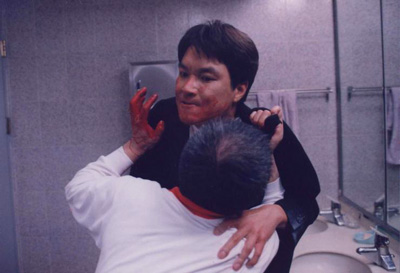
I've been working my way backwards through the filmography of Korean novelist and director Lee Chang-dong. A couple of years ago I saw his then-latest film Secret Sunshine (2007) in San Francisco and was properly blown away. More recently I screened Peppermint Candy (1999), another triumph. And just now I've seen his directorial debut, Green Fish (1997). Remarkably, that amounts to the majority of his output; he's only made five films in the last 13 years. But if the other two films are as good as the ones I've seen, he can take all the time he wants. His stuff is worth the wait.

Green Fish follows the progress of a young guy named Mak-dong (Han Seok-kyu) from newly-discharged soldier to low-level gangster via an encounter with a mysterious beauty on a train (Shim Hye-jin). She's a singer in a nightclub owned by local gang boss Bae Tae-gon (Moon Seong-guen), whose moll she is, but she's also got a thing for Mak-dong. If all this is starting to sound somewhat film noir-y, it is. What makes the film remarkable is its utterly unpretentious realism. Such a seemingly hacky set-up works because Lee Chang-dong roots his characters and situations firmly in terra firma, employing a style you could call verite noir. As with his other films, Lee isn't so concerned with conventional story-telling as with direct, visceral human experience. This leads to an unpredictability in his films; standard tropes do not concern him, only raw emotion (and a certain measure of social commentary). But since most films are simply a series of surprises anyway, Lee's approach works, albeit from a completely different direction. The audience's cinematic expectations are thwarted by the rude intrusion of something unexpected that might actually happen.

So, for example, when Mak-dong's brother gets pulled over by a cop, he tries to bribe the cop ... and the cop takes the bribe. Mak-dong's brother only has one large bill and asks the cop for change. The cop agrees, then gets in his car and drives away. So crazy brother chases the cop, demanding his change! Elsewhere an imposing thug from a rival gang bumps into Mak-dong in a store, causing him to drop his groceries. The thug picks them up and apologizes ... in English! Then, moments later, he returns with his cohorts to beat the shit out of Makdong and his pals. Green Fish is filled with moments like these. Things inevitably ratchet up but, again, not in the way you might think, and the film ends on a decidedly unconventional note.

One more reason to see Green Fish is the presence of the incomparable Song Kang-ho (The Host, Sympathy for Mr. Vengeance, JSA, The Quiet Family, Thirst), here playing one of Mak-dong's fellow gangsters. It's an early, small role for Song, but his manic energy is in full force -- any time he's on the screen, you can't take your eyes off him. He would team up again with Han Seok-kyu in the taut political/crime drama Shiri (1999).

Green Fish won the Dragons & Tigers Award at the 16th Vancouver International Film Festival.

Friday, June 11, 2010

They can't all be good ...

Contrary to appearances, I have not been neglecting this blog. I have, in fact, been screening films to write about, but they've all been too sucky or non-shocking to qualify. But then I thought, "Hello, why not write about them anyway?" As Groucho Marx once remarked after a particularly crap joke, "They can't all be good, you've got to expect that." You said it, Groucho!

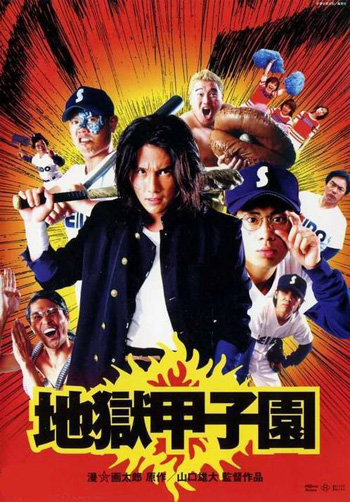
The lamest of the lot by far was Battlefield Baseball (2003). I'd wanted to see this one for years, having heard it was similar to Shaolin Soccer (only with Japanese zombies instead of Chinese martial artists and baseball instead of soccer). Plus Tak Sakaguchi is in it, and I thought he was great in Versus. Imagine my disappointment, then, when I discovered it was utter dogshit. Seriously, I'm willing to forgive a lot in terms of outrageous, manga-esque excess (see my Asia Shock for ample proof), but this film didn't even deliver on the promise of its own outrageousness.

The premise, wafer-thin as it is, is this: A high school principal fears for his prize baseball team when he realizes they're slated to play another team known for mutilating and murdering their opponents on the field. That's it, that's the whole movie. Apparently, the film's budget did not allow for special effects, as all such mayhem happens off screen, leaving us to view a baseball field strewn with cheap-looking body part props. To keep things going, people come back to life, only do the same schtick all over again. Ugh.

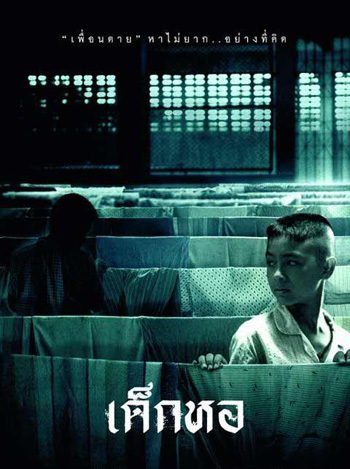
Then I watched Dorm, (2006) supposedly a Thai shocker about a haunted dormitory in a boy's boarding school. Part The Devil's Backbone, part The Sixth Sense, the film isn't bad, in fact it has a gentle charm that infuses what amounts to a supernatural coming-of-age picture wherein a living boy and a ghost boy help each other and those around them. But it sure ain't scary or even remotely shocking.

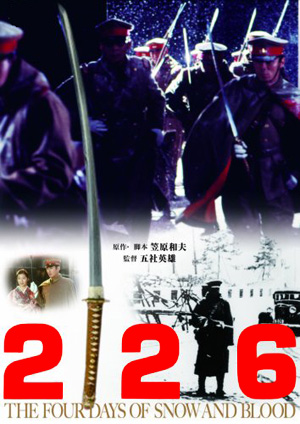
So I decided to throw on a Hideo Gosha film, Four Days of Blood and Snow (1989), about the notorious "226 Incident" that occurred February 26 (hence 226), 1936, in which a group of young Imperial Japanese Army officers attempted a coup de e'tat. Knowing Gosha's visceral style and reputation for brutally realistic screen violence, as well as his string of just-plain-awesome samurai and yakuza films from the 60s and 70s, I figured it was a slam dunk. Gotta be great, right?

Nope. Sadly, whatever Gosha had in 1969 (when he made both Goyokin and Tenchu), he'd all but lost 20 years later. Outside of a thrilling sequence early on, in which the rebellious young officers run around Tokyo assassinating government officials, the rest of the film is just a tedious bore, suffering as it does from the same problem that plagues most films coming out today: No character development. The half dozen leaders of the coup attempt are flat, flat, flat. We are expected to just hit the ground running with these guys without any background, a bunch of wooden toy soldiers spouting the usual nationalistic banalities. Who cares? Wanna know how to make an ensemble piece set in wartime work? Try Paul Verhoeven's The Soldier of Orange.

So now I'm on to the next film. Never fear, dear reader I'll find something good for you. It is my quest, my raison d'etre (and, usually, something I enjoy -- here's hoping I have better luck with Green Fish).