Monday, August 22, 2011

East/West Mash-ups

I've been neglecting this blog shamefully of late, and for those who follow it, I offer my sincerest contrition, along with a couple of reviews.

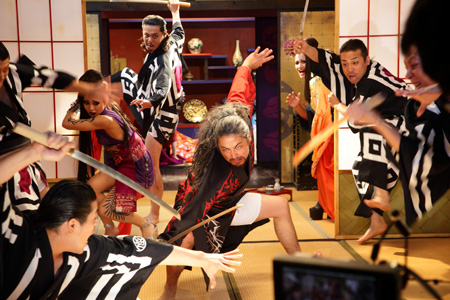
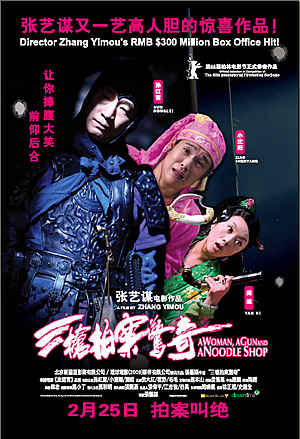
As it happens, I saw two pictures recently worth mentioning, both of which have an East-meets-West connotation. One was A Woman, A Gun and a Noodle Shop (2009). It's a remake of the Coen Brothers' first film, Blood Simple (1984), only set in Ming dynasty China (Gansu province to be precise). It's pretty faithful to the original film plot-wise and a feast for the eyes. Director Zhang Yimou (Hero, Raise the Red Lantern) contrasts the desolate wastes of his locations with brightly colored costumes and talented actors, several of which are also accomplished noodle dough jugglers (you just have to see it). My only complaint is one I normally have with Hollywood films -- no character development. At least not up front -- you are thrust into the midst of the main characters and have to hit the ground running. Eventually they develop, but it's a little rough at first trying to get a handle on who they are and what they're like, as well as whether you give a fuck about them. All in all, though, I found it enjoyable and I got completely sucked in, even though I knew what was going to happen next.
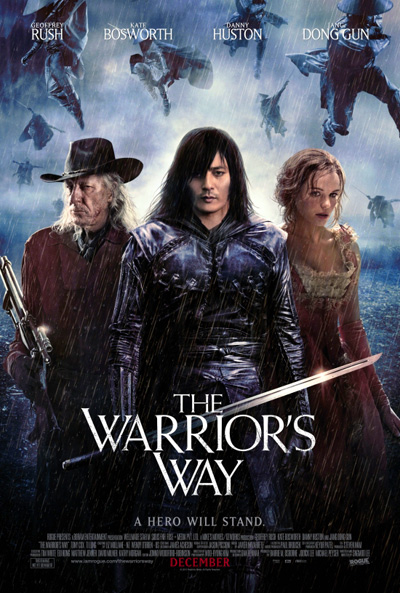
I also enjoyed The Warrior's Way (2010), a rip-snorting western featuring Korean superstar Jang Dong-gun (Friend, Tae Guk Gi, 2009: Lost Memories) as a master ninja. Jang plays it like an Asian Clint Eastwood, handling the language passably. Geoffrey Rush is fun as the irascible town drunk and Danny Houston chews scenery to beat the band as hideous, tooth-obsessed baddie The Colonel. It's just a romp, but rookie director Lee Sngmoo delivers the goods with style and verve, creating a quality picture that augers a promising career. If you were disappointed by the predictable Cowboys and Aliens, perhaps Cowboys and Ninja will be more to your liking.

Tuesday, July 26, 2011

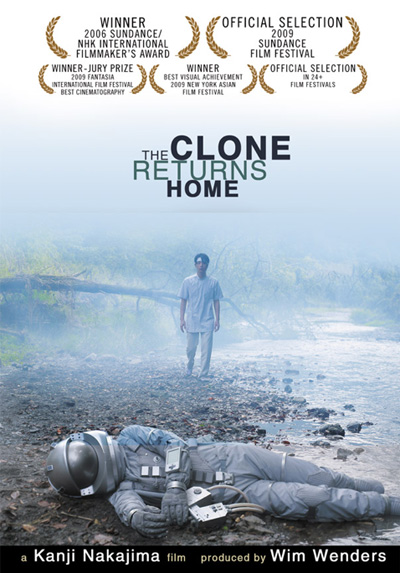
The Clone Returns Home

OK, I never heard of it either. But the good folks at AnimEigo sent me a review copy, so I feel I owe them a review. Unfortunately, this time around it's not going to be a good one.

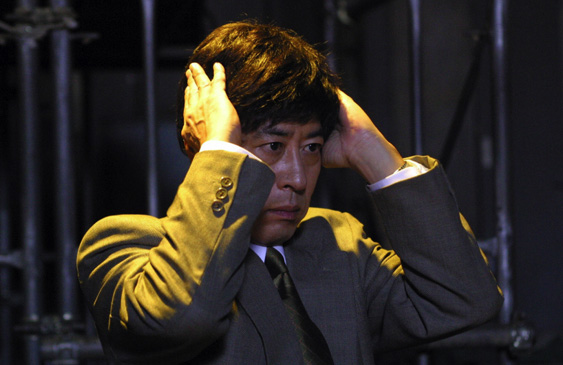
I suppose there is an audience out there for incredibly slow Japanese films (Maborosi comes to mind … ). As it happens, The Clone Returns Home received several awards at prestigious film festivals like Sundance, Fantasia and the New York Asian Film Festival. And I can't for the life of me understand why. Maybe because Wim Wenders was executive producer? Perhaps it was one of those emperor's new clothes things; it's so tedious and boring, it must be good and I'm just not getting it. Nobody had the balls to stand up and say, "I'm sorry, but this is just pretentious and dull."

I've seen a few Japanese art films in my time, and I can go for a slow burn with the best of them. I love Kubrick at his slowest (Barry Lyndon anyone?). Kubrick is obviously an influence here, in the form of 2001: A Space Odyssey, but the compositions don't warrant such loooong lingering shots, and the actors need not pause like junkies nodding out between every line.

I will admit the film gets interesting about 55 minutes in when talk turns to the spiritual ramifications of cloning and what becomes of the souls of the original person and his clones (unlike a lot of film critics, I actually welcome a little philosophical inquiry in a film). However, things snap right back to dull-as-dishwater a few minutes later and stay that way for the rest of the flick.

If you liked the film Moon (the one directed by Zowie Bo-- er, Duncan Jones), you probably would like this film too, but certainly not in its current form. Actually, while I'm no fan of remakes of Japanese films, this one could actually benefit from the Hollywood treatment (wow, never thought I'd say that).

So sorry AnimEigo, I'm a big fan of every other Japanese film in your catalog, but I'm afraid you've got a dud on your hands with this one. Slow as molasses, The Clone Returns Home is a test of anyone's attention span. Watching this film made me realize what ADD must be like.

Thursday, June 23, 2011

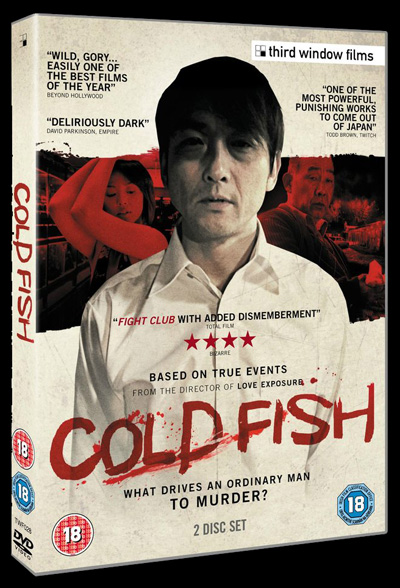
Cold Fish

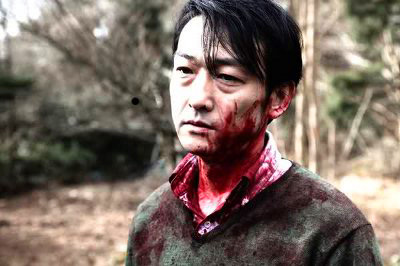
I originally saw this film last fall at Pusan (and said this). Upon re-screening, I think it no exaggeration to state that, with Cold Fish (2010), Shion Sono has created the definitive serial killer picture. Based on actual events, the film conveys a raw reality that is so much more chilling than Silence of the Lambs-style theatricality. Here, you're going to get blood on you. Lots of it. Here, characters wallow in the gore -- literally. Cold Fish is the kind of film Asia Shock is all about.

So you've got middle-aged Japanese character actor Denden (Cure, Ju-on, Uzumaki) channeling notorious serial killer Gen Sekine who, during the 80s and 90s with his wife Hiroko Kazama, dispatched, dismembered and destroyed the corpses of four people (that we know of -- there were likely many, many more). Sekine was an exotic animal importer specializing in Alaskan malamutes, so no doubt some of his victims found their way into his dogs. In the film, Sekine becomes Yukio Murata and his specialty shifts from dogs to tropical fish. He's got a huge shop, staffed by teenage girls in tight tees and hot pants. He takes mild-mannered Nobuyuki Shamoto (Mitsuru Fukikoshi), a competitor with a much smaller shop, as his business partner. Unfortunately for Shamoto, a primary component of Murata's business is killing people, and before he knows it, our hapless ultra-wimp protagonist is sucked into Murata's murky world of murder.

I received a review copy of the Cold Fish double disk from Third Window Films and particularly appreciated one of the special features, a half-hour discussion of the actual case upon which the film is based. This comes courtesy of Jake Adelstein, journalist and author of the book Tokyo Vice. Adelstein relates the details of the case in great detail, revealing how accurate the film is to real events (although the plot goes in a completely different direction in the third act). Adelstein also offers insights into the way murder is investigated (and often not) in Japan. Apparently 80,000 people a year go missing in Japan, and only 4% of suicides are investigated. So it seems that a lot more people are being murdered in Japan than is reflected in official records.

Anyhow, if you're a fan of serial killer flicks, you've got to see Cold Fish. Fan of Japanese film? Even better. And if you like sushi … there's a moment in the film that will forever color your sense of it. Enjoy!

Thursday, June 16, 2011

Japan Cuts in NYC

Summer in New York City means one thing to Japanese film fans: movie time! Beat the heat next month at the fifth annual Japan Cuts film festival brought to you by the Japan Society. Partial proceeds go to the Society's Japan Earthquake Relief Fund. Follow the links for more details and enjoy all those cool flicks for me while I sit here in the woods and whittle.

Wednesday, June 15, 2011

The Rug Cop

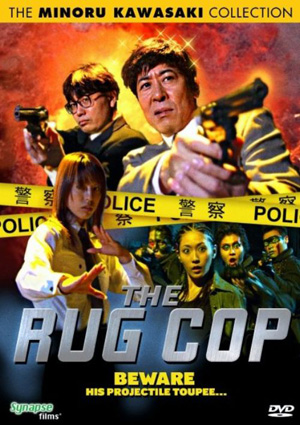
There's nothing particularly shocking about The Rug Cop (2006) -- it's just a silly police procedural spoof concerning a cop with a super-powered wig. But I haven't blogged for awhile, so I figured I'd better post something.

If you're a fan of a certain kind of goofy Japanese humor, one that goes for lots of sight gags and dick jokes, you'll find The Rug Cop a pleasantly quirky 78 minutes. Directed by Minoru Kawasaki (who gave us such memorable titles as Pussy Soup, The Calimari Wrestler and The World Sinks Except Japan), the story concerns an aging cop who nevertheless maintains a high arrest record thanks to his amazing rug. In tough situations, he invariably whips it off and throws it at whomever/whatever is endangering him; the hairpiece knocks guns out of peoples' hands, beheads a ventriloquist dummy (he was holding bank employees hostage -- really), the fucking thing even bites. Rug Cop is aided in his investigations by clownish cops with nicknames like Old Man, Big Dick, Handsome and Shorty. It's all very puerile and it probably says something about me that I sat and watched the entire thing.

It occurred to me after screening The Rug Cop that the whole concept likely came from a misinterpretation of the phrase "rogue cop," as "rug cop" sounds about the same in a Japanese accent. So there you have it: One very silly concept based on a mistake. Is it a mistake to see it? Probably. But then you could say that about half the films on this blog!

Friday, May 27, 2011

Exiled

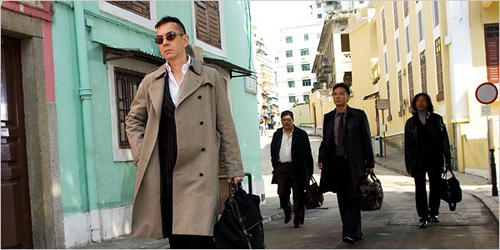
Back in 2007 I attended the 30th Portland International Film Festival (I blogged about it once or twice). One of the films supposedly playing was Exiled (2006). However, every time I went to a scheduled screening, someone would walk out, sheepishly apologize, and tell the audience that the film was still on the way -- sorry, here watch this instead. After a couple of attempts, I gave up on seeing it. Finally screening the film yesterday, I realize it wasn't a great loss.

Don't get me wrong, it's not a bad film. However, it's a Johnnie To film starring Anthony Wong, Simon Yam, Lam Suet, Nick Cheung and Francis Ng -- it should have blown my mind, but instead it merely held my attention. It's a low-key affair, very dark (literally as well as figuratively -- most of it is people silhouetted in inky blackness) with long periods of brooding. There are, of course, the usual explosions of violence, usually protracted gun battles, but there's an emptiness at the center; I just didn't feel a connection to the characters, and the tempo was a bit too adagio.

It's about five guys from Macau, childhood friends, who became gangsters, and one of them apparently shot the boss. Now his four friends are split; two are loyal to the boss and have been dispatched to rub him out. The other two are loyal to him and determined to stop the other guys. At least that's how it starts. But you know how gangsters are, always flipping sides. This goes for the bosses as well, and before long everyone is blasting away.

Simon Lam turns in a frightening performance as Boss Fay, but Anthony Wong merely phones it in (or perhaps he was directed that way -- I don't know, I'm forever ruined after seeing his performances in The Untold Story and Ebola Syndrome). Lam Suet, the John Goodman of contemporary Hong Kong cinema, is great as usual, and Nick Cheung shows his range (compare his taciturn family man here with his vicious assassin in Beast Stalker).

I need to see more Johhnie To films (and there are certainly plenty to see), but this one just didn't do it for me. I much prefer something like PTU.

Thursday, May 19, 2011

13 Assassins

For those of you who find the contemporary samurai films of Yoji Yamada a bit dull, have I got the film for you! I'm not normally a fan of remakes, but I've got to hand it to Takahsi Miike -- once the enfant terrible of Japanese indie cinema, our boy is all grown up now, making modern samurai films that attempt to capture the horrendous realities of living and dying by the sword. In 13 Assassins (2010), he more than succeeds.

Whether intentional or not, the film begins as something of a mindfuck. The early scenes are virtually a shot-for-shot recreation of Eiichi Kudo's 1963 original. I was thinking, "Oh great, another Gus Van Sant Psycho affair." However, things become distinctly Miikean around ten minutes in, with a graphic beheading followed by the image of an emaciated, limbless, naked woman bleeding from her eyeballs. Miike is clearly upping the stakes here, but he manages to do so while remaining loyal to the story, as well as the spirit, of the original film.

Playing the central role of Shinzaemon Shimada is Koji Yakusho, one of the few remaining Japanese actors in the same league as the samurai stars of old. A protege of the great Tatsuya Nakadai, Yakusho made his film debut alongside his teacher in Hideo Gosha's most excellent Hunter in the Dark (1979). Us folks in the West became aware of him as the foodie gangster in white in Tampopo (1985). He's since appeared in scads of great Japanese films including Kon Ichikawa's Dora-heita, Shohei Imamura's The Eel, Shinji Aoyama's Eureka and a whole slew of Kiyoshi Kurosawa films. Needless to say, he's great in 13 Assassins. His character is much more engaged in the action than his predecessor (who only entered the fray of the final fight right at the end).

While I still have reservations about Miike's upcoming reworking of Masaki Kobayashi's immortal Hara-Kiri, I will anticipate it with somewhat less trepidation having seen 13 Assassins. Miike's definitely maturing as a filmmaker, and while he'll never stand up to the likes of Kobayashi, he just might do justice to the legacy of that great auteur. (Boy, did that sound pompous. Oh well, fuck it, that's what I think.)