Thursday, July 12, 2012

The Last Samurai

It is a time for rejoicing, my friends. One of the finest samurai films ever made has been released on DVD (courtesy of Neptune Media): Kenji Misumi's magnum opus, The Last Samurai (1974). And no, Tom Cruise is nowhere in sight -- this is a completely different (and utterly superior) film. You may be familiar with Kenji Misumi from his wonderful 60s chambara work at Daiei (Zatoichi, Sleepy Eyes of Death), or his early 70s Lone Wolf & Cub films. If so, you've got to see this, his final, and finest, film. (I review it at length in my book, Warring Clans, Flashing Blades, so you'll want to get that as well … )

The Last Samurai is a sprawling saga of the Bakumatsu period, that dark and treacherous time in the mid-19th century that saw the bloody dissolution of the Tokugawa shogunate. Faction fought faction, plots and assassinations played out daily, and everywhere the clank of steel on steel filled the air! Into this maelstrom of violence and deception steps our protagonist, played by tall, dark and handsome Hideki Takahashi. He's fictional, but his friends and the events of the day are all right out of the pages of history. I should mention that his friends are all legendary swordsmen on differing sides of the conflict. You can bet things are going to get much worse before they get any better. Who will survive to see the restoration of the Emperor and the new days of peace, modernization and progress? Probably not many …

Shout out to my NYC bro John Gainfort for sending me the disk, and for all his help over the years. He authored the DVD and was one of the producers, so of course it looks and sounds awesome. This is quality product, from screen to disk to you. Thanks, John!

Honestly, this film is epic, absolutely in my top ten. Whether you're a collector or just want to have a couple of top-notch Japanese films around the house, this is a must-have/must-watch-again-and-again. You know me, I don't get paid to say this (god how I don't get paid) -- this is from the heart. So in short: Good shit, Maynard!

Monday, July 9, 2012

Directory of World Cinema: Japan 2

It occurred to me that I never blogged about this book, to which I contributed five reviews. I suppose it's because the pieces I submitted were pared down versions of reviews that have already appeared in my own books -- nothing new for my readers (both of you) to get excited about. However, it's worth mentioning that the book (along with its predecessor) is full of wonderful reviews and essays covering myriad genres of Japanese film, a fact I confess I overlooked for the sake of my own myopic concerns.

So, for the record, if you have any interest in Japanese film and wish to broaden your horizons, absolutely get this book. And I suggest you get it in print, as it's full of full color production stills which may or may not come with the e-book version.

I understand a third installment is in the works (my friend Dr. Stan Glick will be contributing), so if you find you enjoy the books in this series, there's something to look forward to. Always nice to have something to look forward to.

So run, don't walk, etc.

Wednesday, May 30, 2012

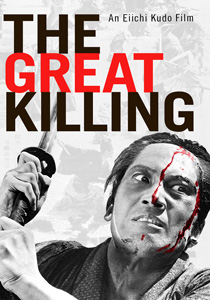
The Great Killing

Eichi Kudo's follow-up to his The Thirteen Assassins (1963) finds a rag-tag band of conspirators plotting the downfall of a particularly nasty government official (downplayed wonderfully by the great Ryutaro Otomo) in mid-17th century Japan. Getting wind of the plot, the government comes down hard, with a brutal "round up the usual suspects" effort that involves quite a lot of traditional Japanese torture of prisoners involving bamboo and boiling water (for starters … ). The eventual blood-letting of the title provides the film's big ending, although it's a much more chaotic affair than that of Thirteen Assassins. Kudo abandons the highly structured, meticulously planned samurai assault of the previous film for an utterly desperate and unruly free-for-all.

The Great Killing (aka The Great Duel) is a somewhat stranger animal than its predecessor. There's a certain angularity, a kind of cinematic alienation to the proceedings. Long, enigmatic shots from odd angles and frequent use of hand-held camera provide an unconventional air; this is certainly not your typical Toei chambara of the period. Character development is kept to a minimum, so the central characters' motivations are unclear (at first), as is the nature of their relationships to one another. Kotaro Satomi, who you'll remember as the handsome young wastrel of the previous film, is back as innocent samurai bystander Jimbo, who gets sucked into the fray with no choice but to join the conspiracy; the lovely Nami Munakata (in her screen debut) plays the mysterious Miss Miyi, whom everyone wants to sleep with (she is a stunner); Mikijiro Hira, star of Three Outlaw Samurai and Sword of the Beast, plays his standard dissipated cynic; and seasoned character actor Toru Abe is on board as the military strategist behind the Big Killing itself.

As usual, Animeigo offers their top-flight subtitles with interstitial gloss to help you through the more abstruse aspects of Tokugawa-era politics and social etiquette. Animeigo is to samurai films what the Arden editions are to Shakespeare. You're in good hands, never fear. Shimpai gomyo!

Thursday, May 17, 2012

Eros High School: Feels So Good

My contact at Synapse sent me a couple more films from their Impulse label's Nikkatsu Erotic Films Collection (a series of 70s and 80s softcore porn flicks originally known by the industry term Roman Porno). Synapse plans to release 15 of these titles, and seeing as how I feel obligated to review films people send me, I'm going to have to ask them to stop sending them, as I don't want to come off like a total pervert. That's the Phantom of Pulp's job!

Don't get me wrong, I enjoy a sexy Japanese movie every now and then, and while these films never show full frontal nudity, much less actual penetration, nevertheless they're incredibly filthy. With the exception of international warfare, the Japanese invariably master whatever they set their minds to, and in the realm of softcore porn, the Japanese "pink film" is nonpareil.

Looking at the packaging,  you can pretty much guess what's on the table here: At least one Japanese high school girl gets the business from a guy in a straw hat (while holding a track shoe no less! No, not really ...). Turns out the guy is the self-styled Ryu the Rapist (Shohei Murakuni), a geta clog-wearing punk with a pet pig who goes back and forth between reform school and standard high school because he rapes women and girls wherever he goes. He's set his sights on pretty track star Misa (Asami Ogawa), but he's going to plow through all of her friends and a number of other girls first. The rapes start off violent, but of course the girls start to love it soon enough (an unsavory sentiment, the merest hint of which got Sam Peckinpah in hot water over his 1971 film Straw Dogs). What's truly bizarre is that the film is largely played for laughs. It's that queasy mixture of goofy and disturbing I noticed in so many Category III Hong Kong films (reviewed for your reading pleasure in Asia Shock).

I was also sent #4 in the series, Zoom Up: The Beaver Book Girl, an intriguing title from 1981. This one will likely be a bit more deviant, for as time wore on, the Roman Porno film franchise felt the need to up the ante as it were. I anticipate more wall-to-wall sex and less prurient hijinks than Eros High School.

I should mention that the disks feature informative essays by pink film expert Jasper Sharp, so if you want to pretend you're not just perving out but really doing legitimate film history research, here's your chance. In any case, if you're a heterosexual male with a pulse, you're sure to get turned on by this terrifically titillating film fare. (These films hit the street June 12, 2012.)

Tuesday, May 8, 2012

13 Assassins

A year ago I reviewed this film in conjunction with the Miike remake that had then recently come out. My reference print was a high quality bootleg, but since AnimEigo has released their own version, I have to endorse it in accordance with my long-standing relationship with them (and the fact that they totally rock). Where else do you get on-the-fly, color-coded subtitle gloss? You don't get any closer to a scholarly reading of a samurai film than AnimEigo, forget about it.

So yeah, read my review, buy this disk, and shut the fuck up (oops, did I type that or only think it?). Standards are eroding all over the place -- like Frank Zappa once said, "Either you get it or you don't." Here's hoping you do. More on the AnimEigo release here.

Thursday, March 29, 2012

The Nikkatsu Erotic FIlms Collection Vol. 1 & 2

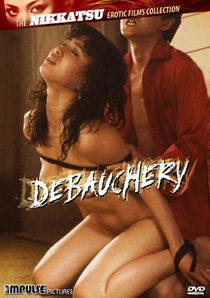
The folks over at Synapse Films/Impulse Pictures are celebrating Nikkatsu Studios' 100th anniversary by releasing what they are calling The Nikkatsu Erotic Films Collection. They were nice enough to send me the first two volumes, Debauchery (1983) and True Story of a Woman in Jail: Sex Hell (1975). As some of my readers may know, Nikkatsu, Japan's oldest movie studio, made a business decision in 1971 to all but abandon traditional filmmaking for what they speculated would be a much more lucrative proposition: softcore pornography. They called it Romantic Pornography (Roman Porno for short), and, as planned, it was a big hit, despite a total lack of visible genitalia or even pubic hair. This is down to Japanese filmmakers' endless creativity when it came to depicting sexual activity -- it's amazing how hot a sex scene can be without ever seeing anyone's privates! Plus an effort was made to class things up with compelling storylines, decent acting and high production values.

Debauchery is the more intense of the two films on offer, due in part to when it was released; the advent of VHS and availability of more explicit fare meant Nikkatsu had to raise its game, content-wise. The film runs just 70 minutes, and 69 of them are sex scenes (well, that's an exaggeration, but not by much ... ). The premise looks to be taken from the Luis Bunuel film Belle de Jour (1967), in which a bored, affluent housewife decides to work part time as a prostitute. In the case of Debauchery, the woman in question (played by the lovely Ryoko Watanabe) gets way more than she bargained for, particularly in the realm of kink -- B&D, S&M, whips, belts, beads, the humiliation and degradation mounts until she's finally walked on all fours on a leash down an alley, only to be given over to a bunch of dirty bums. Distasteful? Yeah. But well made, enough so to hold my interest. If kinky Japanese sex hijinks is your thing, you can't go far wrong here.

As for Sex Hell, as you can guess by the extended title, it's a Women in Prison picture, and fairly decent as far as this genre goes. There's a lot more story and character development here as well as plenty of lurid sex. Unfortunately most of the women aren't very good looking, plus I'm not a real big fan of WIP flicks (with the exception of the Female Convict Scorpion series starring Meiko Kaji). That said, if you are, you'll probably enjoy this entry in the genre.

These two films street on April 10 and hopefully more will be released before the eventual demise of the DVD format (get those disks while you can, collectors!). Actually, I just checked and there's a third title (more info here). With all the garbage coming out of Hollywood these days, a nice Roman Porno could be an exciting change of pace. If you've never seen one, now's your chance!

Friday, March 9, 2012

Triad Trilogy

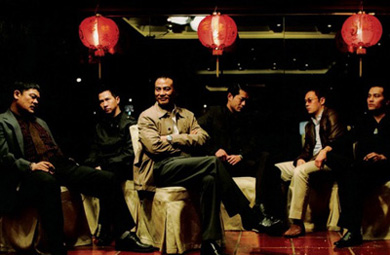
Lam Suet, Nick Cheung, Simon Yam, Louis Koo, Eddie Cheung, Gordon Lam
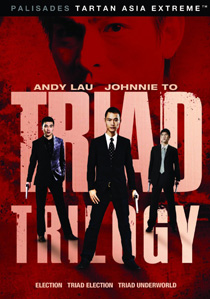
This DVD contains three films: Election, Triad Election, and Triad Underworld. Trilogies are popular, so I understand Palisades Tartan's marketing strategy here. Add the whole triad thing, and it's oh so very clever. However, while this disk offers much and is a great value for the price, it's not a proper trilogy. You get two great Johnnie To films and one not-so-great gangster flick whose title sounds like a Johnnie To film. So, in fact, with all the talk of triads and trilogies, three ain't the magic number here. We're talking twofer.

Let's dispatch the bad egg first. Director Wong Ching-po is no Johnnie To, and Triad Underworld (2004) is far from being in the same league as the other two films on offer here. Underworld wants for subtlety or style, the music is awful, the cinematography is grainy (looks like they shot it in 16 mm and blew it up) and the narrative tone moves queasily between sappy sentimentalism and ham-fisted violence. It's not that Wong doesn't try; there's a tense scene between two gangsters that employs the old Vertigo-style dolly zoom to enhance the tension (probably picked up from that scene in Goodfellas), and the twist ending is somewhat creative (but ultimately unnecessary -- it plays like a whimsical afterthought).

Underworld Triad's greatest strength is its cast. The great Andy Lau (Infernal Affairs, House of Flying Daggers) plays triad kingpin Hung with his usual easy good looks and easy manner; Jacky Cheung is his loyal (?) lieutenant Lefty (lost a hand in service to his bro); Edison Chen and Shawn Yue play Turbo and Yik, two handsome young losers desperate to become gangland up-and-comers; HK film stalwarts Norman Chu and Eric Tsang appear in small roles as rival gang bosses; we even get XXL character actor Lam Suet in a tiny role as an abusive cop (his roles would grow throughout the 2000s).

Election (2005) is a completely different animal, an excellent film that won scads of awards (four Hong Kong Film Awards, 2 Golden Horse Awards, 2 Hong Kong Film Critics Society Awards, etc.) placing Johnnie To squarely in the big leagues. It stars Simon Yam (Dr. Lamb, Triangle, PTU, Exiled) and Tony Leung (not the Tony Leung from Infernal Affairs -- that's Tony Leung Chiu Wai -- this is Tony Leung Ka Fai) as two gangsters vying for the coveted position of chairman of the Wo Sing triad. Lok (Lam) is even-tempered, serene almost, but Big D (Leung) is a violent hothead. So when Lam is elected chairman, Leung doesn't take it well and threatens a gang war. A desperate scramble ensues to secure the 100-year-old baton that symbolizes the power of the chairman -- whoever gets a hold of it can claim the post. The hunt for the baton is something of a MacGuffin quest and goes on a bit -- the only weakness of the film. Otherwise Election is an intense, engrossing crime flick from beginning to end. The ending is a jaw-dropper, to be sure. Also starring super-cool Louis Koo (Connected, Accident, Triangle), Nick Cheung (Exiled, The Beast Stalker, Connected) and Lam Suet (Exiled, Accident, PTU -- yeah, I know, there's a lot of overlap).

Triad Election (2006, aka Election 2) picks up the story two years later, just in time for another election. Our man Lok doesn't want to give up the position and is prepared to kill to keep it (more than prepared, in fact … ). However the favorite is his lieutenant Jimmy (Louis Koo), although Jimmy himself wants out -- he's keen to be a businessman in China. But get this: In order to secure the rights to do business in China, he has to be a triad chairman (go figure). Now he's forced to do all sorts of nasty shit to get to the top of the heap, the last thing he really wants. At one point, in order to intimidate a group of rival henchmen, he kills one, chops him up, grinds the meat and feeds it to vicious dogs in front of them. Talk about commitment!

Triad Election raises the stakes in terms of action, violence and treachery. Johnnie To was clearly trying to top Election, and its successor is definitely the stronger and tighter of the two films. I saw Triad Election years ago but hadn't seen its predecessor, so many moments of dramatic irony were lost on me. Seeing it again, and hard upon Election, improved my film experience immeasurably. Viewing the two films back to back is the best, and a good reason to get this disk. Nevermind Underworld Triad, you can skip it -- or, if you've got 82 minutes to kill and nothing better to do, check it out. But it's the To films that are really the gems here, and not to be missed!