Wednesday, February 23, 2011

Sleepy Eyes of Death Vol. 2

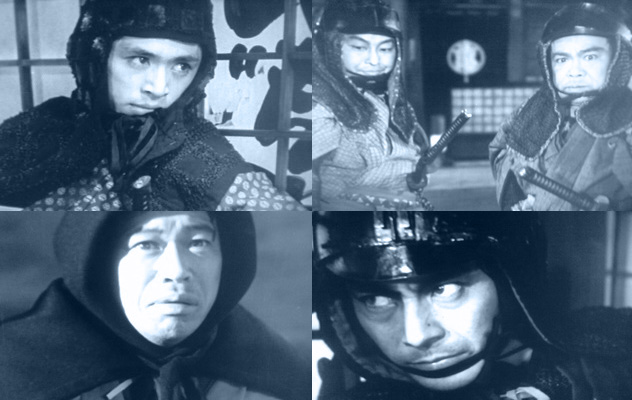
My friends over at Animeigo were kind enough to send me a copy of their latest Sleepy Eyes of Death box, the second in what will be a trilogy of quadrilogies (there are twelve films in all, featuring the great Raizo Ichikawa). It's been a long time coming, and it truly warms the heart of an old samurai film fan like me to see these fine films in disk form at last. (Animeigo had previously released the first six films on VHS back in the '90s.) This is one of the all-time best samurai film series ever made, one that should be on the shelf of every true fan of the genre.

I won't go into plot synopses here -- suffice to say you'll find the usual array of corrupt clan officials, deadly temptresses, machinating merchants, vengeance-seeking samurai, secret Christians, pirates, ninja, the sadistic Princess Kiku from film #4 and at least one cherubic child. What really makes these films so enjoyable is central character Nemuri Kyoshiro, that supremely cynical, red-headed ronin, played to bitter, smirking, full-moon slicing perfection by Ichikawa.

If you're a fan of Zatoichi, you'll see plenty of familiar faces, as both film series were released by Daiei Studios during the same period, featuring the same contract players and made by a rotating stable of excellent house directors including Kenji Misumi, Kimiyoshi Yasuda, Kazuo Ikehiro, Akira Inoue and Kazuo Mori. Actors appearing in the films of this box include personal favorites Shigeru Amachi, Tamao Nakamura, Ryutaro Gomi and, of course, the great character actor Saburo Date.

Times are tough right now for specialty outfits like Animeigo, and god forbid they're unable to release the final batch of Sleepy Eyes of Death films -- I urge all my friends and fellow fans out there to support Animeigo by purchasing these excellent film sets. They really are must-haves for anyone into this most magnificent of film genres. Oh, and if you haven't already, buy my books!

Monday, January 31, 2011

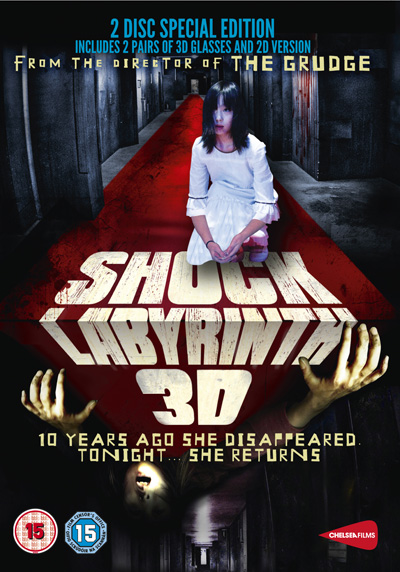
The Shock Labyrinth

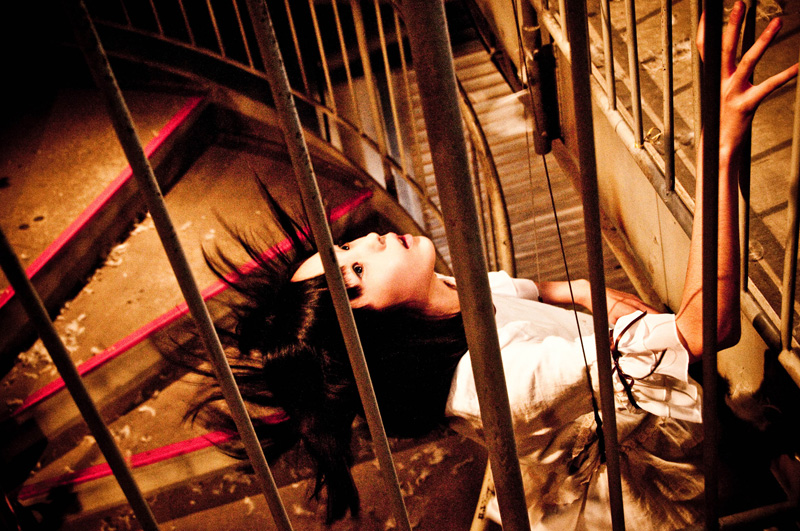
Roughly two and a half hours north of Tokyo, near the base of Mt. Fuji, you'll find an amusement park called Fuji-Q Highland. The big attraction there is the massive Haunted Hospital, the largest haunted house attraction in the world (according to Guinness). This is the setting for Takashi "Ju-on" Shimizu's first 3D effort, The Shock Labyrinth (2009). The 3D aspects of the production were lost on me -- more about that in a minute …

The Shock Labyrinth is one of those horror pictures that opens with a series of inexplicable images and then sets about explaining them. Slowly. Yes, this film is a slow burn, so much so that I had serious doubts until about 30 minutes in, when things finally started to gel. In the classic formula, there is a woman who has been grievously wronged (to death) and now seeks revenge. In this case, the female ghost in question died as a child, at the hands of one or more of her small coterie of friends, in the Haunted Hospital (they snuck in after hours, got lost, things went horribly wrong, etc.).

Ten years later, the surviving friends are all grown up and having a strange night, particularly due to the fact that the girl they all thought dead has shown up at their door. She's acting weird and soon has an episode that requires medical attention. The group drives her to a nearby hospital -- a hospital that bears an uncanny resemblance to … you see where this is going? Things go from strange to surreal. Are they all dead? Have they entered an alternate dimension? Is all this happening in the mind of one of them? You'll find out, eventually. It's almost as if The Shock Labyrinth was made for a second viewing -- it's so much better the second time around. It's as if you have to get the first viewing out of the way before you can really enjoy it!

Fans of art house auteur Hirokasu Kore-eda may recognize young actor Yuya Yagira from his devastating film debut in 2004's Nobody Knows. He plays the pivotal role of Ken in The Shock Labyrinth. Also on hand, portraying pretty blind girl Rin, is Ai Maeda, who was also in Battle Royale (she was Shiori, and her sister Aki was Noriko). And if you're very observant, you'll recognize Suzuki Matsuo from Ichi the Killer and the risible Robogeisha.

Oh, about the 3D: The DVD package comes in both standard and 3D editions. I tried the latter first, wearing the old-timey red/blue cardboard glasses supplied … for about 90 seconds or so, before ripping them from my face, tears running from my burning eyeballs. Nope, that didn't work for me. But then I'm not a big fan of the whole 3D thing, not even the new, high-tech version you get at the cineplex these days. I find it more a distraction than anything else, another run at the same old gimmick. I caught the end of Avatar the other day on my satellite dish at 1080p and it looked way better than it did in the theater with the friggin' glasses on. I'm guessing the same goes for The Shock Labyrinth. So to hell with the 3D, just sit back and enjoy this enigmatic, ultimately enjoyable J-horror creation in glorious, it-ain't-broke-so-don't-fix-it 2D.

Monday, November 29, 2010

Pat live in Portland

Hey, if you're in Portland, Oregon on Friday, December 10th and have nothing better to do, why not fall by the Northwest Film Center and take in a samurai film? Namely The Hidden Blade (2004), the second in Yoji Yamada's Samurai Trilogy. I'll be introducing the film; I also wrote a bit about it in Warring Clans, Flashing Blades. There will be a book-signing after the screening, so if you've already bought a copy (god bless you), bring it and I'll sign it. Otherwise, there will be copies available for purchase. See you there!

Wednesday, November 10, 2010

The Secret of the Urn

Another film I reviewed in my 2005 tome Stray Dogs & Lone Wolves: The Samurai Film Handbook was The Secret of the Urn (1966). I'm revisiting the film (as well as Destiny's Son) for the sake of Wildgrounds Blogathon 2010, as I feel the film is such a supreme achievement in the genre that it deserves a second look (or first look if you haven't seen it).

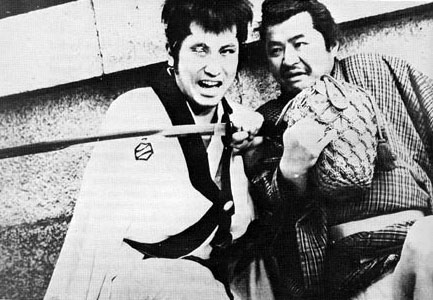
The legendary Kinnosuke Nakamura plays a one-eyed, one-armed wild man of a ronin named Tange Sazen. His injuries were received at the hands of a treacherous chamberlain who used the young samurai's loyalty to lord and han for his own nefarious purposes. Now this bakemono (monster, as most who encounter Tange Sazen call him), lives out his days in bitterness and mental instability. But boy can he swing a sword! Into his lap falls a tea urn inscribed with some secret writing leading to a fortune in ryo (gold coins), a million of them to be precise. The urn and gold belong to the Yagyu clan, and they need the one to find the other (the very fate of the clan depends on it). There are other factions and more layers of intrigue which I won't go into here.

The film was directed by Hideo Gosha, one of the Great Ones of samurai cinema. Therefore you have a more realistic level of screen violence (think blood and body parts), innovative use of moving camera, and the general sense of kinetic urgency emblematic of Gosha's style. The Secret of the Urn is an excellent film that also boasts an excellent cast. As with my last two posts, at least one member of the Seven Samurai is present, in this case Isao Kimura (who played the young guy samurai who falls in love with the farm girl). Then there's Seizaburo Kawazu, here playing a machiavellian shogunate official; he was in everything from Yojimbo to Tattooed Life to New Tale of Zatoichi to Mothra. Of particular interest to samurai film nerds is the presence, in a small role, of one Ryutaro Otomo. A Toei studios stalwart of the 50s and 60s, Otomo himself starred as Tange Sazen in at least half a dozen films, his first in 1952. (His version of the character was far more comical and OTT than Nakamura's here.) One wonders how he felt playing a high-ranking magistrate trying to convince Tange Sazen to leave town ...

So there it is. You can get a copy of Secret of the Urn here (you won't find it on Amazon). It's a great film, a fantastic entry in the genre, and just a roaring good time. Oh, and if you're interested in learning more about the character of Tange Sazen, I discuss him at length in my follow up to SD&LW, Warring Clans, Flashing Blades: A Samurai Film Companion.

Friday, November 5, 2010

Destiny's Son

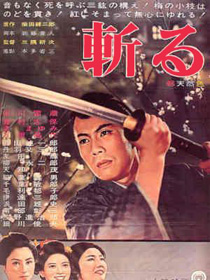
I reviewed Destiny's Son (Kiru, 1962) in my first book, Stray Dogs & Lone Wolves: The Samurai Film Handbook, and it occurred to me that I hadn't seen this wonderful film since then, so I thought I'd revisit it. I'm pleased to say it's lost none of it's magic, none of it's power. If anything, it just gets better each time I see it. A perfect synthesis of Zen and bushido, I can safely say it's among the finest samurai films ever made.

The film stars the immortal Raizo Ichikawa as the proverbial man born under a bad sign. For starters, his mother was beheaded by his father shortly after his birth. No, it's not like that -- she was under penalty of death for having assassinated her lord's mistress (on orders from the chamberlain) and no one in the han was willing to carry out the sentence. She was actually pleased when her husband stepped forth, happy to die at the hand of the father of her child. (Gotta love that samurai class … )

Our hero is adopted by a kind man and raised up to be a good country samurai, but treachery soon rears it's ugly head, sparking a series of cataclysmic incidents that send the young man spiraling into the uncertain life of a wandering ronin. Oh, did I mention he's a brilliant swordsman? Would have to be, right? He's got this great form that so unnerves his opponents, they drop to the floor in exhaustion just trying to find some way to fight him.

This being a Kenji Misumi film, the visuals are gorgeous, the pacing tight, and the fight scenes thrilling. It's also one of three Misumi films I'm aware of where someone gets sliced in half … lengthwise. Yep, from topknot to tail, the guy just sort of flops open. Mind you, it's all very tastefully done, from a distance, so don't expect some horrendous blood bath. Blood is used sparingly in the picture, but effectively.

As for cast, all your Daiei favorites are here: Shiho Fujimura (mom); Shigeru Amachi (dad); Masayo Banri (a fugitive who strips off her clothes to create a diversion, bless her); Saburo Date (a duplicitous retainer) and of course Raizo. Also on hand is Seven Samurai alum Yoshio Inaba (the smiling one), here playing a murderous creep who cuts down Raizo's adopted father and sister.

If you don't feel like waiting for the next Raizo Ichikawa retrospective at your local arthouse to get a look at Destiny's Son, you can pick up a copy here. I can guarantee you won't regret it. And, if you haven't already, why not get a copy of Stray Dogs & Lone Wolves? My original review is better written and more thought out than this on-the-fly blog post. Up to you.

Thursday, November 4, 2010

Vendetta of Samurai

This lesser-known entry in the samurai film canon will be of great interest to Kurosawa fans. Vendetta of Samurai (Araki Mataemon: Ketto kagiya no tsuji, 1952) features four of the seven samurai from Seven Samurai (Takashi Shimura, Toshiro Mifune, Daisuke Kato and Minoru Chiaki), as well as rubber-faced old farmer Yohei (Bokuzen Hidari). Vendetta relates the true story of a meticulously planned ambush and attack upon a mounted party protecting a murderer.

Leading the revenge is Mataemon (Mifune), a sword instructor and brother-in-law to young Kazuma (Akihiko Katayama) whose brother was recently slain by fellow clansman Matagoro (Chiaki). Mataemon and Kazuma are joined by chubby old Buemon (Toranosuke Ogawa) and chubby young Rokusuke (Daisuke Kato), forming a four-man vendetta squad. (Sorry, I realize that's a lot of names to throw at you, but not nearly as many as come flying at you in the film itself!)

Anyhow, the whole gimmick of the film, and it's a good one, is to show you what such an event must have really been like, in contradistinction to the legendary battle it became over time (in which Mataemon supposedly slew some 36 men). The opening of the film portrays just such a battle, a kabuki moment of sheer fantasy in which we see Mifune, Shimura and others covered in make-up, Mifune practically doing pirouettes as he slashes attackers left and right. I couldn't believe what I was seeing; I'm well acquainted with the work of director Kazuo Mori, and such corny, stagey samurai foppery was completely incongruous with his style. Then the voiceover explained things: This is how this famous incident is traditionally portrayed, whereas the film we're about to see is the real deal, how things really happened. I appreciate what the film sets out to accomplish, and consider it largely a success. There are moments of tedium, but I understand they're deliberate, in service to the realism of an actual ambush -- there's bound to be longueurs, no getting around it.

Vendetta was a Toho production, although Kazuo Mori is better known for his work at Daiei, helming scores of films throughout the 50s and 60s including a number of Zatoichis and Nemuri Kyoshiros. Of the films of his I've seen, my favorite is probably The Tale of Zatoichi Continues (Zoku Zatoichi monogatari, 1962), starring Shintaro Katsu and Tomisaburo Wakayama.

Vendetta of Samurai is an eye-opening look at what really happens when frightened men with big swords find themselves up against it. Some find courage, others lose heart, and some will invariably lose their lives. This is one film that tells it like it is and doesn't sugar coat the stark realities.

Japanese Film Blogathon 2010

Hey everbody, head over to Wildgrounds for the 2nd annual Japanese Film Blogathon. All the hip Japanese film bloggers (including yours truly) will be weighing in on their favorite films, offering fantastic insights and insider knowledge. The event runs through November 11th, so check back early and often!