Saturday, May 7, 2011

Revenge

AnimEigo has released Tadashi Imai's 1964 samurai classic Revenge (Adauchi), which I reviewed in Warring Clans, Flashing Blades. In the book, I stated my opinion that the film is good but has problems. It suffers from uneven pacing, underdeveloped characters and a confusing use of flashbacks (are we now or are we then?).

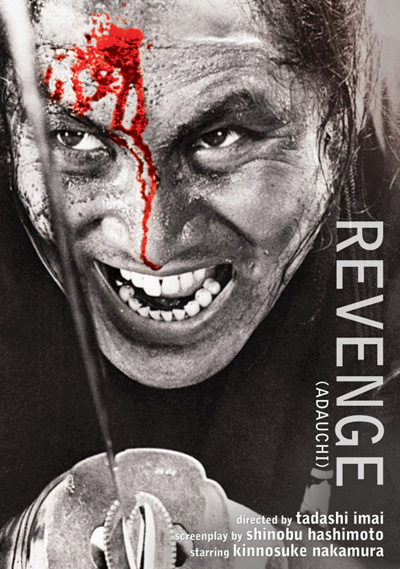
That said, Revenge boasts strengths as well, chiefly in the performance of its star, Kinnosuke Nakamura. Nakamura was the most emotive of the samurai stars of the 60s, and here he gives 110%. He plays a low-ranking samurai who duels a haughty superior and wins -- against the wishes of his clan (who promptly banish him to a mountain monastery). Things go from bad to worse when the slain man's brother shows up (the inevitable Tetsuro Tamba). Before long the clan elders want our hero dead, and as the pressure mounts, so does his anxiety, fear and rage (see box cover, above).

My opinion of this film is in the minority, as most critics hail Revenge as a masterpiece. Its political allegory works and, as I said, Kinnosuke Nakamura is mesmerizing. So decide for yourself and feel free to add a comment.

Friday, April 22, 2011

Confessions

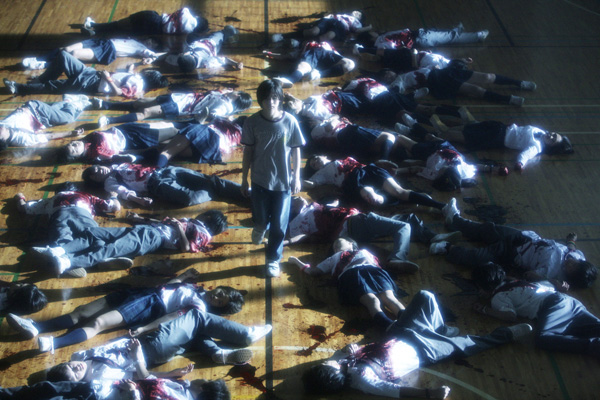
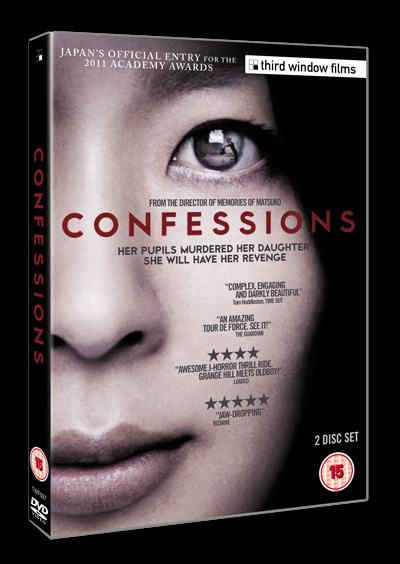
Confessions (2010), a harrowing tale of psychosis, child murder, AIDS, parricide and revenge, is currently winning awards. It just won Best Asian Film at the Hong Kong Film Awards and previously received Best Film, Screenplay and Director at the 34th Japanese Film Awards. It was also Japan's entry for Best Foreign Language Film at last month's Oscars. So who am I to dispute such accolades? I'm Pat Galloway, that's who, and I just will. For while there are some great things in this film, ultimately, in my opinion, the fundamental flaw of its execution is what defeats it.

And what might that be? Confessions is an adaptation of a novel by Kanae Minato, and moves from one first-person confession to another of a group of people brought together by a murder. Narratively, this concatenation of personal admissions works fine in a novel; film-wise -- not so much. What results is a near nonstop voiceover throughout the film. Blah, blah, blah, the chatter never ends. After awhile it gets to be somewhat unnerving. Film is a visual medium, and telling a story with images is its primary strength. Ironically, filmmaker Tetsuya Nakashima (Kamikaze Girls, Memories of Matsuko) does a fine job in this department. Unfortunately, he ruins the striking visual dimension of his film by covering it in a thick layer of verbal diarrhea. I can understand his dedication to the source material, but common film sense should have dictated a more sporadic use of voiceover. The way he's done it might seem daring to some, but for me it just doesn't work.

The story revolves around the murder of a school teacher's young daughter and the revelations that result from her frank disclosure to her class that two of their fellow students committed the murder. The path of her revenge takes various twists and turns, and the fallout from the initial murder leads to madness and more killing for the two young perps. Takako Matsu (who played the lovely Kie in Yoji Yamada's The Hidden Blade) delivers a slow-burn performance that culminates in a (literally) explosive grand finale. This comes, however, at the cost of a tedious 30-minute speech at the opening of the film which nearly put me off the whole picture.

So yeah, clearly my opinion is in the minority, but I do encourage you to see this film and decide for yourself. As I said before, there are a number of things to recommend it. The dual themes of the nature of evil and the essence of grief are compelling, complimented as they are by a sombre soundtrack that features songs by Radiohead (I kept thinking, "That singer's doing a Thom Yorke impression …"). Superbly shot and idiosyncratically edited, it is visually challenging and innovative. A shame about all that yakking. In the end, it all comes down to the old adage: Show, don't tell.

Saturday, April 9, 2011

The Man From Nowhere

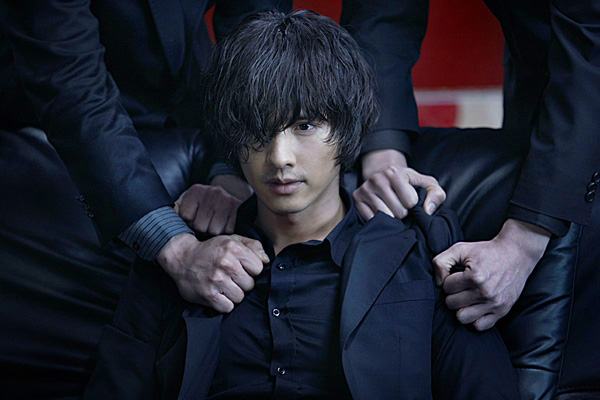
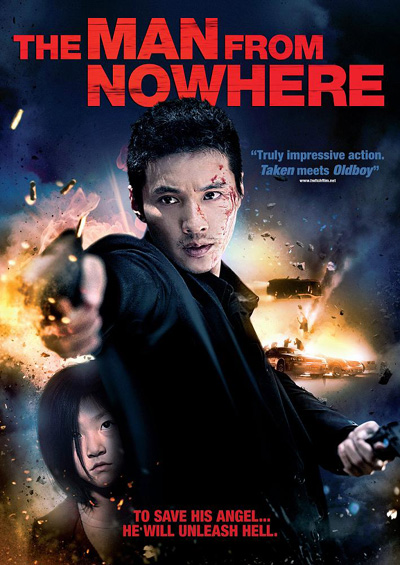
Korean superstar Won Bin proves he's more than just a pretty face in this ultra-violent crime/revenge thriller, a film that grabs you by the [your sensitive body part here] and literally does not let go until the final frame. Like fellow up-and-coming director Jang Hun (Secret Reunion), Lee Jeong-beom proves that a sophomore effort can totally kick ass as he proceeds to take what could have been yet another routine trawl through the Seoul demimonde and raises it to the heights of classical tragedy.

A cursory look at the story elements (mysterious loner, cherubic child, gangsters, cops, drugs, organ harvesting) is sure to elicit a "ho hum" from the jaded Korean film aficionado. However it's the film craft and performances that transform The Man From Nowhere (2010), ennoble it, and make it something special. Because of this, there's not a lot left for me to say -- I could go over the not-that-interesting-on-paper plot, or describe the gory details of the various gun/knife/axe/nail gun sequences, but what's the fun in that? Surely you'd rather see it, yes? Let my enthusiasm be your guide -- I've seen a boatload of these films, and if I found this one riveting, so will you.

What's that, I'm copping out? OK, let me add that the cast all give 110%, particularly leads Won Bin (as the mysterious loner badass) and wee Kim Sae-ron (as the impossibly cute little girl he must protect). Won Bin, you'll recall, was in the gut-wrenching Korean war epic Tae Guk Gi (2004), the film that broke him globally, although he was already a big star across Asia from his appearance in a number of popular Korean TV dramas, chiefly Autumn in My Heart (2000). Following the blockbuster success of Tae Guk Gi, Won dropped out of sight for five years, entering the military for real for his compulsory service and then suffering a severe knee injury. He made his comeback with Mother and, now, The Man From Nowhere. Something tells me he's going to be around awhile ...

I should add that The Man From Nowhere was a box office smash in Korea, the highest-grossing film of 2010, bagging a whole slew of Korean Film Awards including Best Actor, New Actress, Editing, Music and Visual Effects. It was on my to-see list at Pusan last year, but had already played by the time I got there (screwed the pooch on that one ... ). Thankfully, lovely PR people send me screeners, so now I'm up to speed and telling you this is one hell of a film not to be missed.

Wednesday, April 6, 2011

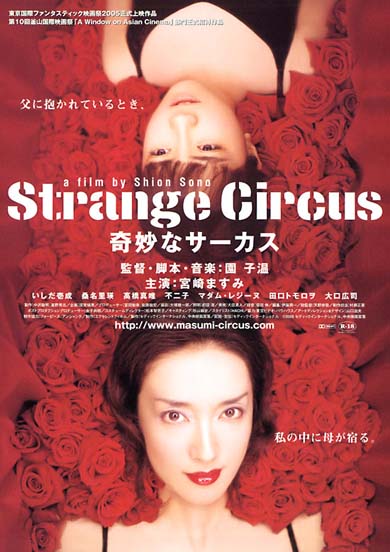
Strange Circus

[Note: Japanese cult director Shion Sono's given name is frequently spelled "Sion." However, it's pronounced "Shion" -- "si" is nowhere in the Japanese syllabary. So I'm going with Shion.]

Shion Sono's films are a mixed bag to be sure. At the brilliant end of the spectrum there's Suicide Club (see my full-length review in Asia Shock), Love Exposure and Cold Fish. Down at the crap end you'll find Noriko's Dinner Table and now, not quite so far down but definitely in the vicinity, Strange Circus (2005).

On paper, Strange Circus has it all: Near-hardcore sex, insanity, gender-bending, extreme body modification, incest, dismemberment, psychedelic fantasy sequences featuring fat transvestites, and the odd beheading. Add to that Rampo-esque touches like someone hiding in a cello case observing others having sex. Yes, it could have been so much more, but the pace, oh the slogging pace -- just kills it. To his credit, Sono seems to sense just when he's about to lose his audience completely, doling out plot points right at the last moment to keep them from bailing. I came close several times, to be sure.

So what's it about? OK, you've got a love triangle between a father, a mother and a daughter. In true Electra-complex fashion, the girl fucks her dad and kills her mom. Later the daughter grows up to be a mad novelist -- is all the transgression of her past just her literary fancy? Does she even know? A young editorial assistant from her publishing house wants to find out, and his investigations into her sordid private life reveal things that … well, I don't want to blow it for you should you decide to stick it out on your own.

Strange Circus offers more than enough bizarre imagery and memorable moments to haunt you for years, especially if you're a newcomer to extreme Japanese cinema. Just wish Sono could have made it flow better ...

Friday, April 1, 2011

Rough Cut

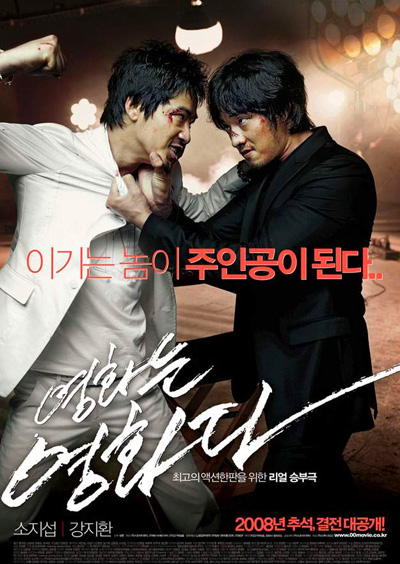
When I was in Pusan in October, I saw a great film called Secret Reunion, an outstanding sophomore effort from director Jang Hun, and I knew I had to see his debut film, Rough Cut (2008). Although "Rough Cut" is a typically slick, slapped-on afterthought of an English title (the Korean title, Yeong-hwa-neun Yeong-hwa-da, translates as "A Movie is a Movie"), it describes the film fairly well. I get the pun: "rough cut" is an industry term, and there's a lot of fighting in the film. However in the case of the film itself, it's literally rough in the cutting. Some cuts are abrupt and confusing, like visual non-sequiturs. This is a common problem with first-time directors -- they're still getting their arms around the gargantuan responsibilities of film directing. Some things are bound to fall through the cracks. However, in the case of Rough Cut, the strengths far outweigh the weaknesses.

Jang Soo-ta (Kang Ji-hwan) is an actor with anger management issues and one hell of an attitude. His specialty is gangster pictures and he's as tough offscreen as on. Only problem is: kicking your fellow actors' asses for real on the set -- it's just not done. Soon nobody wants to work with Soo-ta. Enter Lee Kang-pae (So Ji-sub). He's a real gangster with a yen to be an actor. He has a run-in with Soo-ta early on, and, as you've no doubt guessed by now, winds up shooting a picture with him. He too has an interest in kicking ass for real (hey, it's his job), and proposes that the two men just go for it, no holds barred, in every fight scene. What results is somewhere between Fight Club and All About Eve.

Given the premise, and the fact it's a Korean film, you can bet your bottom won there's gonna be wall-to-wall whoopass. The male leads are cool and tough, the love interest (Hong Soo-hyeon) is smokin' hot, the gangland b-story is tense, and the pace is relentless. Nevermind the occasional bad edit, Rough Cut is a gripping, brutal adrenaline rush from beginning to end. And Jang Hun is a director to watch.

Tuesday, March 22, 2011

Secret of the Urn (again)

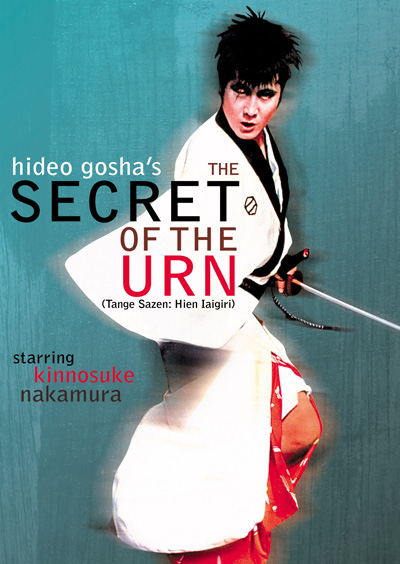
It's a great film, a fantastic entry in the genre, and just a roaring good time.

That's what I said in a recent blog entry regarding Hideo Gosha's samurai classic Secret of the Urn (1966). So you can imagine how surprised I was to read those very words on the back of the box containing Animeigo's new DVD release of the film. Hey, that's me! And it is!

I originally wrote about Secret of the Urn in my first book, Stray Dogs & Lone Wolves. The blog entry was a revisit for the sake of last Fall's annual Wildgrounds' Japanese film blogathon. So between book and blog, I've said pretty much what I want to say about this fine film. Now it's your good fortune to have it readily available. My advice: Carpe diem, temups fugit and that -- snap it up and cherish it.

Wednesday, March 9, 2011

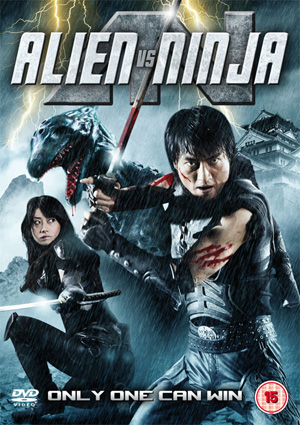
Alien Vs Ninja

The worst thing about contemporary action drama is the practice of presenting a group of undeveloped, cookie-cutter protagonists and expecting the audience to identify with and care about them as they spring into action. There's a name for people we know nothing about. They're called strangers. And we tend to not give a fuck about them. We usually need to get to know someone first before we start to care about them -- it's just human nature. That's why in drama there's something called character development, and it is this element that is sadly lacking in most action films today.

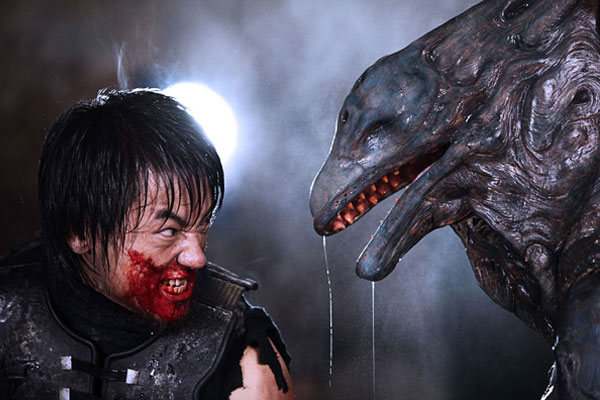
Now you might think I'm expecting too much from a movie called Alien Vs Ninja, but in fact character development does occur over the course of the film (albeit on the fly). So the first act was fairly wasted on me. But the film gets better as we get more acquainted with the spunky young ninja, fighting their hearts out to save their village from the vicious onslaught of their reptilian/humanoid foes.

You've got your main hero, full of gusto and derring-do, his sullen, preening pal, the hot chick, the comic relief guy and the traumatized teen. OK, still pretty cookie-cutter. What ultimately saves Alien Vs Ninja is a combination of hyper-kinetic fight scenes (utilizing swords, mixed martial arts, wire fu, shuriken, biting, nut shots, you name it), over-the-top, splatterific gore and just an overall gonzo, go-for-it vibe. No gag goes unexploited, and there's a nuanced comic underpinning to the film that makes it more enjoyable -- no one is taking themselves too seriously here, and the film is stronger for it. Basically it's a romp.

The top-notch action choreography comes courtesy Yuji Shimomura who also worked on Versus and Death Trance. The heroic male leads, newcomer Masanori Mimoto and seasoned pro Shuji Kashiwabara, are truly awesome fighters, absorbing Shimomura's swift, tightly orchestrated moves seemingly on a molecular level. (Wow, I guess I wound up liking this film more than I thought ... ).

So if you're out for some gory ninja hijinks and feeling particularly like a fourth grader, you can't go far wrong with Alien Vs Ninja, a low-budget actioner redeemed by winning performances and sheer panache.