Wednesday, September 18, 2013

Champions

Ever since Netflix hired me to tag films for them, I've been getting an unofficial education of sorts. Initially, I was hired on as an Asian film expert, but soon enough things started to splay out, and I found myself assigned to all sorts of cinematic stuff, a veritable grab bag of filmic experience. In addition to numerous kung fu fight fests, I've seen everything from 70s skin flicks to hip hop high school romps to Kazakhstani historical epics.

And documentaries. Lots of documentaries. I've screened documentaries about eels, prescription drugs, film criticism, Steve Jobs, New York cabbies, forensic science, black punk rock bands, Sturgis -- you name it. But seeing as how this blog is dedicated to Asian film, I give you … another kung fu flick. Don't get me wrong, I really liked this movie -- I just wish they'd send me a Japanese film every now and then (haven't seen one since Sadako 3D back in July).

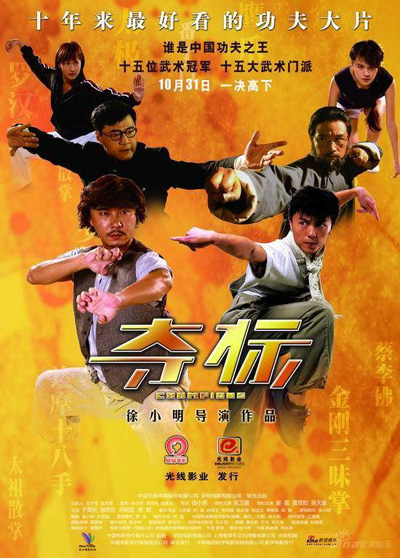
Anyhow, the film I want to discuss is Champions (2008). This film, set in the 30s and concerning a group of martial artists and runners who seek to compete in the Olympic games, was clearly made to rev up the masses for the actual Olympic games of 2008 (there's even a reference to the year inserted into the script). Therefore, it's a bit (or rather very) propaganda-y (yeah, that's a word I just made up). The cheery, let's-go vibe is quite strong at the outset (think hoo-rah, song-and-dance set pieces) but soon enough, things get down to some serious kung fu ass-kicking. Beneath the rah-rah, there is a film eager and capable of opening a big old can of Mantis Grip/Eagle Claw Fuck You and Die in Pieces You Bastard.

There are two villains, an unscrupulous martial arts master and a gangster, and they create most of the conflict in the film. What's most compelling is the size of the opposing groups. On the protagonist side we have Cheung Fung (Dickey Cheung), the smart-allecky upstart, and Kwan Shue Po (Xio Miao), the righteous one, as well as a whole host of locals with skills. And, of course, the bad guys come in waves. This is one of those films where, at any given moment, tons of people flood the screen.

What I used to hate about kung fu films was the elaborate, over-choreographed fight scenes. But recently, and certainly in Champions, there's been a movement away from such tiresome exercises, toward a more compelling (and lightening-quick) style of fight sequence. Fights still go on a bit, but now there's such a melding of speed and technique and wire-fu, plus (taking a page from Hollywood) explosions -- it's POPCORN time!

So if you get Netflix, Champions is coming your way (they give the films to me for tagging slightly before they put them online). I was never a subscriber before they hired me, but now that I've had a chance to check out their offering, I'm impressed with the number of Asian film titles on offer (tons of Korean flicks). I can see why people are tossing their cable boxes and opting for streaming services. Viva la revolution!

Thursday, August 22, 2013

Ip Man: The Final Fight

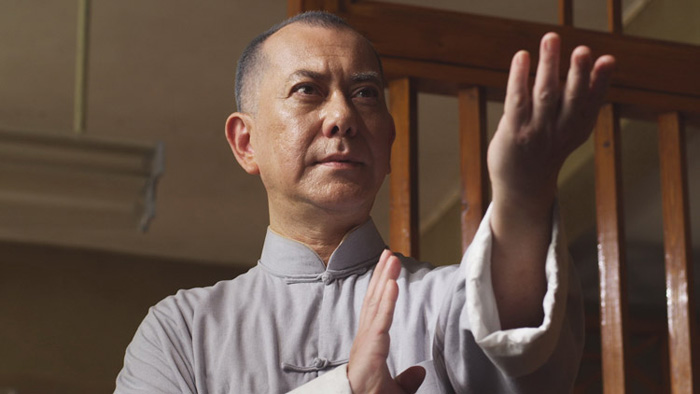
Ip Man (1893 - 1972) was a Chinese martial arts master who famously trained Bruce Lee in the Wing Chun school of kung fu. There's been a spate of Ip Man movies over the last few years, and I just saw the latest one, Ip Man: The Final Fight (2013). Now I'm not the biggest kung fu flick fan, but I have to say I genuinely enjoyed this one. It features the creative efforts of director Herman Yau and star Anthony Wong who, together, gave us such classic 90s Category III films as Ebola Syndrome and Eight Immortals Restaurant: Human Meat Roast Pork Buns (aka The Untold Story). Mr. Yau sure has come a long way since then; this is a high profile, mainstream affair with great production values and a transporting period setting (post-war Hong Kong).

Anthony Wong has been my favorite HK film star since forever (see Asia Shock for details), so seeing him as Ip Man in his later years (Wong is getting up there himself) really made the film for me. Wong has such gravitas, and it feeds perfectly into the role of a noble, charismatic kung fu master living out the last years of his life in 1950s/60s Hong Kong, teaching a group of students (who become his de facto gang) and kicking ass in spontaneous street brawls and within the notorious Walled City of Kowloon.

Keep an eye out for the girl selling barbecue pork buns -- that's an inside joke. And appreciate the use of digital effects to enhance the story. This is a particularly sophisticated take on the martial arts genre, with warmth and insight seldom seen in such pictures. (Geez, was that condescending enough?)

Wednesday, July 31, 2013

The Gangster

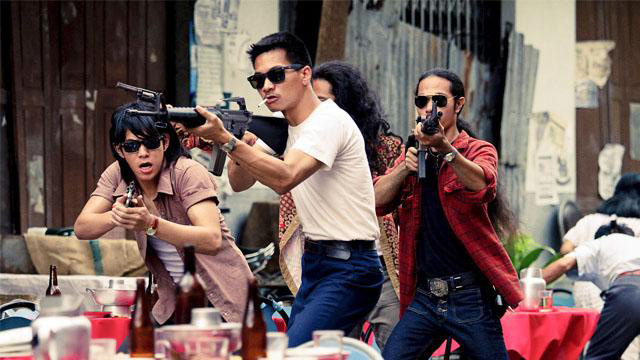
Saw this Thai gangster flick called -- wait for it -- The Gangster (2012). Actually there are a bunch of gangsters in it, but the main character is a super-tough guy named Jod (Krisada Sukosol Clapp). All of the gangsters portrayed were real guys, and the film is intercut with old farts who knew them reflecting on their hijinks.

Actually, "hijinks" is way too light a word for the kinda shit these guys get up to. This is one of the more violent films you're likely to see any time soon. It starts out in the early 60s, when it was just knives and clubs and Elvis hair (these guys had a serious hard-on for Elvis) and runs into what looks to be the early 70s, by which time it was all long hair and guns … lots of guns.

Violence doesn't just explode in The Gangster, it erupts! And, of course there are the usual turf wars and rivalries within gangs leading to treachery. The ending is a bloody barn-burner. I don't want to be Mr. Spoiler, so I'll just say it plays out like a Shakespearean tragedy, if you get my meaning. OK, so I spoiled it for the English majors, but the rest of you nudnicks are in for a shock.

I didn't know what to expect with The Gangster. I'd never heard of it; Netflix assigned it to me. But I'm really glad I saw it, and I encourage those who like Asian cinema and gangster films to give it a go.

Wednesday, July 17, 2013

Sadako 3D

Just when you thought you'd seen the last of Sadako, that creepy, long-haired ghost girl from all those Ring films, well here she comes again. And in 3D no less. Seems the Japanese are taking a page from the Hollywood playbook and providing a sequel no one was asking for.

Sadako 3D (2012) is about a guy named Kashiwada (Yusuke Yamamoto) who wants to resurrect Sadako. He manages this by throwing a bunch of girls down the same well she crawled out of. Then he makes a video of himself being killed by the ghost and somehow, even though he's dead, manages to post it online. And guess what happens if you watch it? Yep, you DIE. Our Miss Ghost reaches right out of your cell phone and pushes you out the window (or whatever).

Seems that although Sadako is back in action, she needs a human host to inhabit, and has chosen pretty high school teacher Akane (Satomi Ishihara). But Akane has powers of her own ...

Actually, the film isn't that bad. It's got some good jump scares and a very interesting innovation on the Sadako brand towards the end involving a monstrous, quasi-insectoid variation on the young lady that's truly unsettling. Plus the usual array of 3D gags where stuff jumps out at you -- always fun. Should be streaming on Netflix any day now.

Wednesday, June 26, 2013

The Guillotines

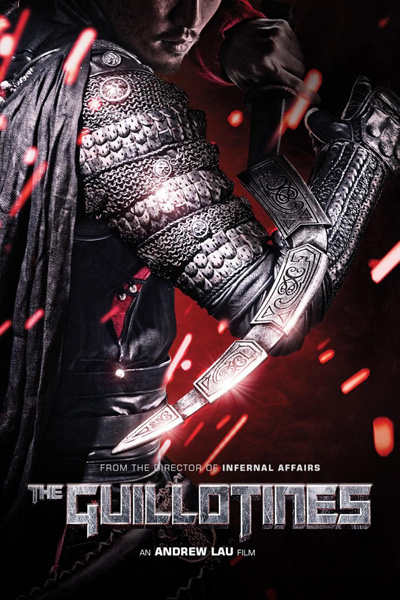
Years ago I saw a Hong Kong flick, Master of the Flying Guillotine (1976). The gimmick was this device, a head-sized ring with concealed blades you could throw like a frisbee, and it would land on some guy's head and somehow fall down to his neck. Then you'd pull on the attached chain and -- well, you get the picture. The flying guillotine had a sack attached to it so the head would be conveniently contained.

Years later (last year), Hong Kong filmmaker Andrew Lau Wai Keung thought it would be a good idea to revisit this whole flying guillotine concept. And you know what? He was right. The Guillotines, an effects-heavy action jaunt, rocks the steampunk/action tip, but I had a problem: Not enough flying guillotines! No sooner is the concept offered up than it's largely abandoned for other story elements.

So it's like this: You've got this elite group of assassins called ... wait for it ... The Guillotines. They all employ the flying guillotine one way or another (there are various models). The emperor sends them on a mission and, well, you'll see … everything goes horribly wrong. The guy they're supposed to eliminate, a cult leader, is in fact a righteous dude. Moral dilemma!

You know me, I usually only review films I like, so if I'm talking about The Guillotines, it's a good bet (even if you never heard of it). It's also a tearjerker (at the end) so your girlfriend will like it too. Dude, what are you waiting for?

Wednesday, May 15, 2013

Nightfall

Sometimes you start watching a film and you just know there's a big twist ending coming. And you're pretty sure you've figured out what it is. And then the twist comes and it's totally not what you were expecting. That's awesome! And Nightfall (2012) is just such a film.

The great Nick Cheung plays an ex-con named Wang (incorrectly listed as Wong on IMDb, plus the HK disk subs I saw had Yang -- go figure) who's just done 20 years for a rape/murder he may or may not have committed. In fact, finding out whether he did it or not is one of the main objectives of the film. Then there's the brutal murder of a famous symphony conductor right after our mystery man (who hates the conductor for some reason) gets out of the joint. This comes to the attention of Detective Lam (Simon Yam), a depressed widower who lives for his job. He's going to get to the bottom of things, and the whole backstory gradually unfolds, taking us deeper and deeper until we reach the devastating denouement.

Extra points for Cheung and Yam -- seeing these guys go up against each other is pure Hong Kong film bliss. Yam is getting up there in years (he runs slowly and painfully in chase scenes), but he's still got it. Readers of this blog may have noticed I mistakenly called him "Simon Lam" a few times (I've since gone back and fixed that). I apologize; I must have been thinking of his unforgettable performance as the title character in the notorious Category III nasty Dr. Lamb (reviewed in Asia Shock).

If you like HK film, police procedurals, mysteries and don't mind a bit of ultraviolence (the opening scene is fairly brutal), you can't go wrong with Nightfall, a stylized and truly absorbing piece of film-making.

Tuesday, May 14, 2013

Tai Chi Hero

This was one of the first films assigned to me by Netflix -- yes, that's right folks, they're paying me to watch movies (and then enter metadata into their system; it's a part-time, freelance gig, but in these tough times I'm glad to have it).

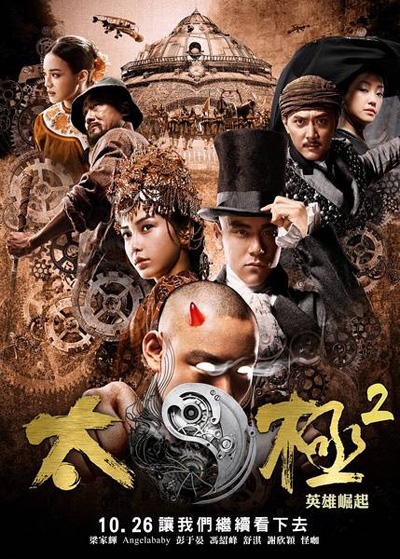
A refreshingly upbeat, steampunk take on the period martial arts film, Tai Chi Hero (2012) is actually a sequel aka Tai Chi 2: The Hero Rises, renamed for an unsuspecting (and presumably uncaring) Western kung fu film viewership. It starts off with a lightening fast recap of the previous film -- man, those subs just fly by. For a slow reader like yours truly, it was more than a struggle to keep up!

And the pace stays pretty breathless throughout. The eponymous hero of the story is one Yang Lu Chan (1799 - 1872), famed innovator in the practice of Tai Chi (not the slow kind your Chinese grandma does in the park -- this is the quick-as-a-whip, ass-kicking variety). He gets married to bitchy yet beautiful Yu Niang (played by someone named Angelababy), and she proceeds to train him in her family's secret kung fu method. Meanwhile, her black sheep brother Zai Yang returns to the family full of secrets. He's an inventor and has created a fantastical flying machine (that apparently made a big splash in the first film).

There are numerous subplots, one in particular involving, of all people, Peter Stormare, the freaky Norwegian fellow from Fargo, here playing another heavy, a representative of the East India Company. Unfortunately, his storyline has less impact if you didn't see the first film.

If you're into Hong Kong film, watch this space; Netflix seems to be sending me HK films at a 3-1 ratio to Japanese films (sadly no Korean films -- someone else does those). As usual, I'll only be writing about the films I'd recommend (2012's The Treasure Hunter didn't do much for me, for example -- see? It ain't here). Next up: HK crime flick Nightfall.